Translate

Monday, 8 April 2013

Private Clouds and Storage Virtualization – Interview with Roni Putra, CTO DataCore Software


Interview Notes By: Manish Sharma, General Manager & Vice President for APAC during a recent meeting with Roni Putra, CTO DataCore Software
Intro:
DataCore has nearly 10,000 customers around the world ranging across Geographies, Verticals and a wide cross section of customers including the largest Government and Enterprise Organizations to medium sized companies. Therefore being a new addition to DataCore, I was very eager to learn more about our technology and use cases and meet one of the Company’s Founders, CTO Roni Putra who was in Malaysia and crossed over the straits to visit customers and partners in Singapore earlier this year.  Below are a few of the key questions that I addressed to Roni:

Manish (MS): Roni, what is the main value that DataCore provides to our customers?Roni Putra (RP): We designed DataCore SANsymphony-V to provide powerful storage features that manage, accelerate and auto-tier the full range and diversity of storage devices ranging from Flash/SSD to SAS/SATA drives to Enterprise Storage Arrays and Cloud storage. The compelling value is that we are ‘pure’ software – the customers deploy DataCore once and they can then continue to use their existing infrastructure or refresh their hardware and storage systems without worrying about compatibility in the future. We ‘future-proof’ our customer investments. Our customers can enjoy the benefits of Auto-Tiering, Centralized-Management, Faster Performance by Caching and Asynchronous Replication etc. using their existing storage hardware investments and infrastructure.

MS: Does the new storage virtualization layer add new complexity while delivering these benefits?RP: We have always designed various versions of our software with the singular goal that the resulting architecture reduces the burden on storage administrators through greater automation and is greatly simplified after deploying DataCore. Our software automates many tasks and provides powerful wizards and tools like ‘Heat maps’ that show bottlenecks in the infrastructure. Within a datacenter, we free up management resources required to administer multiple storage systems and wherever possible we leverage the use of existing system management tools. Therefore, we have introduced plug-ins for VMware vCentre under our broader integration with vSphere and integration to Microsoft Hyper-V in addition to other systems management tools. We also have a DataCore Ready Program to allow an even greater ecosystem of partners to provide proven solutions to DataCore customers.

MS: How does DataCore fit with the software defined datacenter vision?RP: We are software. We are therefore complimentary to the Software centric Datacenter.  Our technology can be deployed in a myriad of ways providing storage services to meet the needs of applications within the Datacenter: Performance, Availability, Replication, Snapshots, CDP, Auto-provisioning, etc. Our software can be deployed either as traditional SAN storage or within the applications hosts, alongside the base operating system or as a Virtual Storage Appliance. The flexibility of the solution allows for deploying hierarchical storage services architecture. Enabling appropriate storage services at the various levels; caching for performance closest to the application, replication at the SAN storage endpoint. We can run DataCore on a VM or on a server.

MS: Roni, we designed DataCore to run with and on Microsoft Windows, what were the considerations at that point when we first designed DataCore?RP: Let me start by saying that today we run on top of Microsoft Windows Servers and that we use Microsoft as a compatibility layer to the outside world, however when we run as a storage server we optimize and serve storage resources to all the name brand operating systems including Linux, UNIX, Microsoft, Netware, VMware and Apple systems. In effect anything that recognizes a SCSI LUN. Windows is usually the first platform to support innovations and technological advancements in hardware and peripherals.  Thereby assuring that our software will leverage the same alongside Windows. Our background in systems architecture and operating systems (Unix, Real-Time and massively parallel architecture) provided the team ample experience to choose a platform that could evolve and meet diverse needs as well as balance the difficult compatibility and performance demands of storage. Knowing the pedigree of the windows kernel architecture team was also a key.

MS: In Addition to delivering performance to Business Critical Applications – what are other sweet spots where our customers get biggest value?RP: In addition to Application performance, customers are deploying Virtual Desktops and DataCore caching along with Solid State Drives to serve Virtual Desktops from Servers at response times that make VDI viable. Continuous Availability is another key benefit that DataCore delivers to our customers.

We bring the needed Storage Agility to Data Centers that allows them to achieve the vision and benefits they expect from a dynamic and service oriented Private cloud.

RP: Manish, I have a question for you – when will I get some lunch – you promised me some good Italian food.MS: Right away Roni, Right away – lets go and eat J


Thursday, 4 April 2013

Simon Birbeck, Waterstons becomes one of three DataCore Master Certified Engineers in the UK


Announced at the recent DataCore Northern Europe conference, Simon Birbeck, Waterstons, is awarded DataCore Master Certified Engineer status, received from DataCore’s Bjarne Poulsen, elevating him to the ranks of elite engineers for the most complex environments. 

Park Resorts Upgrades Data Centre Resiliency and Speeds up Application Performance Using DataCore and Dot Hill Solution


Park Resorts www.park-resorts.com, the UK’s leading providers of family holidays with over 39 coastal parks, are using DataCore’s SANsymphony-V storage hypervisor solution running alongside Dot Hill’s Assured SAN Arrays to lead the great escape away from slow I/O speeds and unpredictable application responses.

Ajay Patil is the Infrastructure Manager responsible for the storage and virtualisation infrastructure throughout the group from the Hertfordshire head office. With vacation spend in a recessionary decline overall, UK based ‘Staycations’ have become a popular alternative to travel abroad in recent years and Park Resorts have enjoyed a 6% increase in annual growth year-on-year. However, as with the entire industry, costs need to be realistically contained to facilitate growth, maintain competitive edge and ensure future scalability.

As it was, nine months ago, Ajay noted issues in the existing storage infrastructure with hardware falling out of warranty and a notable decrease in the performance of applications running on virtual machines (VMs). For the user, this would manifest in poor performance of applications and I/O bottlenecks leading to unpredictability when querying the company database and a reduction of productivity at peak times. Ajay commented: “Whilst a brief delay in inputting a holiday booking or ordering an extra activity onsite may not seem critical, vacation time is so precious and the environment so competitive, that we want to keep the whole Park Resort experience hugely positive, from the moment a holiday is considered to returning the keys on departure.” Keen to facilitate a solid and reliable solution that would be future-proofed for years to come, Ajay called upon trusted storage & virtualisation partner, NCE, to provide independent advice and latest recommendations.

NCE Solution Re-engineers the Park Resorts Storage Infrastructure with Performance, Agility and Scalability
Having successfully virtualised their server room with VMware some years prior, Park Resorts remain fully aware of the compelling benefits of virtualisation to achieve higher service levels through reduced server overhead. NCE undertook a full mapping of the existing environment in order to identify the performance gaps. Ajay explains, “Our key requirement was to ensure that we put in place a foundation that would not only deliver on our immediate requirements for increased performance and capacity, but would allow us to scale as the business applications, user demands and data sets all continue to grow in the future.”

Resilience, performance enhancement, business continuity were critical success factors, with NCE suggesting additional offsite Disaster Recovery reutilizing legacy storage. They also recommended installation of the latest version of the DataCore’s storage hypervisor with small factor, but high performance, Dot Hill arrays. As Ajay notes, affordability remained a critical acceptance item. “We had to maintain a balance between the features that we needed and the features that although were interesting and attractive, would simply never be used. Reassuringly, the approved solution retained a realistic TCO price point.”

Implementation:
Now there are two DataCore SANsymphony-V virtualisation nodes providing synchronous mirroring for true resilience running at the Hemel Hempstead site. The two nodes are based on Dell R720 Servers running Microsoft Windows Server software. These nodes, combined with a pair of Dot Hill Assured SAN 3000 Arrays for disk-to-disk data protection, form the backbone of the storage solution. The Dot Hill Assured SAN 3000 rack mounted Arrays each offer Park Resorts approximately 4TB of usable storage through provision of Small Form Factor (SFF) 2.5” 15k rpm drives, attached directly over high performance Fibre Channel to the QLogic HBAs in each of the nodes. Both the DataCore Storage Hypervisor and the Dot Hill Arrays arrived ready, and technically certified, with VMware vSphere v5.0.

Full Disaster Recovery and Remote Site failover is provided, using offsite replication over IP to a third DataCore SANsymphony-V Storage Virtualisation node housed some 30 miles away offering asynchronous mirroring. Disaster recovery was made affordable using one of the reutilized legacy storage arrays, with the storage hypervisor running on a Dell R710 Server running Microsoft Windows Server software.

Consolidation and reduction of resources:
Even though Park Resorts had used virtualisation for many years, the knock-on effect of consolidation of footprint, resources, and carbon efficiencies still resonates with the small form factor offered in the solution. Ajay comments, “Onsite, it’s about maximizing every cm of floor space and with the scalable 2U 24bay rack and the transparent software hypervisor layer reducing the need for additional storage hardware, we once again see that our footprint has been dramatically reduced. That’s a great feeling and a significant reduction in resources and ongoing management.”

And looking further afield, Ajay reflects: “With the new infrastructure, we have successfully taken Park Resorts into the next generation of virtualisation efficiency, overcoming the user issues of slower performance of our Microsoft SQL database and eradicating I/O bottlenecks in the process. We know that we have a scalable solution that meets all of our objectives both now, and in the future.”

Wednesday, 3 April 2013

Packed Room Attends Software-defined Storage Panel at SNW Spring 2013 to Learn About Proven Storage Hypervisor Use Cases

Yesterday at SNW Spring 2013 in Orlando, there was a packed house attending the Storage Hypervisor panel session moderated by Mark Peters, senior analyst, Enterprise Strategy Group.

The event was lively and many attendee questions were answered in this educational and informative session.

The SNW attendees were pleased to learn how far the technology has come and how it has moved into the mainstream, being proven within tens of thousands of customers who have already deployed storage hypervisors to achieve dramatic economic and productivity benefits.

While the discussion got spirited at times, it was clear that all the panelist were passionate that the time for 'Software-defined Storage' versus 'Hardware-defined' has arrived.

Check out the post: "Beware Storage Hardware Vendors’ Claims for Virtualization and Software-Defined Storage; Hardware-defined = Over Provisioning and Oversizing"

The handpicked panel of experts, industry pioneers included executives from VMware, Hitachi Data Systems, IBM and of course DataCore Software.

The SNW session - “Analyst Perspective: The Storage Hypervisor: Myth or Reality?” - took place on Tuesday, April 2 at 5:00 pm ET at Rosen Shingle Creek in Orlando, Florida, as part of SNW’s Virtualization Track.

DataCore Software’s President and CEO, George Teixeira, was invited to participate in a panel discussion at SNW Spring 2013 on the storage hypervisor. With trends such as software-defined storage and managing Flash-based technologies and tiers of storage for business-critical application performance the subject of industry discussion, the panel provided an overview on the role of the storage hypervisor, benefits, different approaches, current realities and its future, including its ability to transform the economics of storage.


DataCore Software is the storage hypervisor leader and premier provider of

storage virtualization software. A storage industry veteran, Teixeira co-founded the company and has served as president and CEO since 1998.
Introduced in June 2012, DataCore’s SANsymphony™-V 9.0 – “the Storage Hypervisor for the cloud” –transformed the economics of virtualization for organizations of all sizes worldwide by delivering flexibility, performance, value and scale, regardless of the storage hardware used. Recently, in February 2013, DataCore unveiled its latest version of SANsymphony-V, providing expanding enterprise IT environments, virtualized applications and hybrid clouds extended scalability, added performance optimization and greater cost savings courtesy of robust, new configurability choices.

SNW is the world’s largest independently produced conference series focused on the evolution of architecture for a new world of Big Data and business agility. Produced by Computerworld - and co-owned by Computerworld and the Storage Networking Industry Association - SNW remains unbiased and vendor agnostic. SNW provides a forum of open thought leadership and practical education that defines the spectrum of storage, data and infrastructure solutions available to a highly qualified audience of enterprise technology decision-makers.

Tuesday, 2 April 2013

IDC Analyst and Program Director Carla Arend Discusses Storage Priorities, Cloud and Value of DataCore Storage Virtualization and Tiered Storage for Investment Protection

Carla Arend, Program Director Information Management and Storage Software at IDC on  IDC latest findings on storage priorities, Cloud and virtualization and discusses the role of storage virtualization in investment protection and how it can avoid the classic ‘Rip and Replace’ approach to storage investments by integrating and getting more utilization from existing storage.

View Video: https://www.youtube.com/watch?v=5jkdwGoeTWk


View Video: https://www.youtube.com/watch?v=5jkdwGoeTWk

Sunday, 31 March 2013

DataCore CEO to Speak at SNW Spring 2013 Virtualization Panel on the Role of the Storage Hypervisor and How it Transforms Storage Economics

George Teixeira on Panel to Highlight Performance, Cost Savings and Flexibility of Hardware-independent Storage Hypervisor Software – Detailing Latest Innovations, Benefits and Customer Use Cases

DataCore Software’s President and CEO, George Teixeira, has been invited to participate in a panel discussion at SNW Spring 2013 on the storage hypervisor. With trends such as software-defined storage and managing Flash-based technologies and tiers of storage for business-critical application performance the subject of industry discussion, the panel will provide an overview on the role of the storage hypervisor, benefits, different approaches, current realities and its future, including its ability to transform the economics of storage.
For a summary of the main points, please read the recent blog post by Mr. Teixeira: Storage Hypervisors and Software-defined storage .

Mark Peters, senior analyst, Enterprise Strategy Group will moderate a handpicked panel of experts, industry pioneers and executives from VMware, Hitachi Data Systems, IBM and DataCore. The SNW session - “Analyst Perspective: The Storage Hypervisor: Myth or Reality?” - will take place on Tuesday, April 2 at 5:00 pm ET at Rosen Shingle Creek in Orlando, Florida, as part of SNW’s Virtualization Track.

DataCore Software is the storage hypervisor leader and premier provider of
storage virtualization software. A storage industry veteran, Teixeira co-founded the company and has served as president and CEO since 1998.

Introduced in June 2012,
DataCore’s SANsymphony™-V 9.0 – “the Storage Hypervisor for the cloud” –transformed the economics of virtualization for organizations of all sizes worldwide by delivering flexibility, performance, value and scale, regardless of the storage hardware used. Recently, in February 2013, DataCore unveiled its latest version of SANsymphony-V, providing expanding enterprise IT environments, virtualized applications and hybrid clouds extended scalability, added performance optimization and greater cost savings courtesy of robust, new configurability choices.

SNW is the world’s largest independently produced conference series focused on the evolution of architecture for a new world of Big Data and business agility. Produced by
Computerworld - and co-owned by Computerworld and the Storage Networking Industry Association - SNW remains unbiased and vendor agnostic. SNW provides a forum of open thought leadership and practical education that defines the spectrum of storage, data and infrastructure solutions available to a highly qualified audience of enterprise technology decision-makers.

Wednesday, 27 March 2013

Faster Application Performance Tip: Share Flash Across Virtualized Workloads with Fusion-io and DataCore Storage Virtualization Software


Does your business have a need to speed up response times and provide continuous availability for your critical applications? Core business applications like Oracle, SAP, SQL Server, Exchange and SharePoint often perform poorly when virtualized. More often than not the root cause is data I/O bottlenecks. If you are looking at solid-state memory technologies as your answer, then register today for a 30-minute webinar hosted by DataCore Software and Fusion-io.

At the beginning of the year, George Teixeira –our president and CEO– shared his thoughts on how 2013 would become the year of software-defined storage and pointed out five major trends in the market. One of the trends is that Tier 1 applications will go virtual and performance is critical. Another trend is that SSD flash technologies will be used everywhere; storage is not just disk drives.

Keeping these trends in mind, there are two top issues reported by customers attempting to consolidate virtualized Tier 1 apps which frequently force them to give up. The most striking is related to performance. Consolidation causes apps to run unacceptably slower than when hosted on their own dedicated server. Customers also complain about erratic behavior. This shouldn’t surprise anyone. The apps were originally isolated onto private machines for two reasons; to avoid contention for shared resources, and make troubleshooting and tuning easier.

Server virtualization does a really good job of removing the contention for processing (CPU) resources. The I/O contention for shared storage remains challenging. The ancillary problem appears later, when they realize how susceptible to outages their Tier 1 apps become after consolidation, especially for those who unintentionally introduce single points of failure into their storage configurations.

If you are experiencing slow application performance in your virtualized environment due to data I/O bottlenecks and you are looking at solid-state memory technologies as your answer to help your business, then this half hour webinar will be well worth your time.

Join DataCore Software and Fusion-io to learn how to:
  • Integrate flash memory to overcome I/O bottlenecks in real-world environments
  • Combine flash technology with existing storage
  • Speed up virtualized applications 2X to 5X
  • Prevent storage from slowing down or taking down your applications
Sharing flash across virtualized workloads can help increase user productivity and improve the application experience. A more agile and dynamic business with better user experience and greater IT efficiency are just some of the benefits that can be realized.

When: Wednesday, April 10, 2013 @ 1:00pm EDT (USA Eastern Time)
How: REGISTER NOW!

Looking forward to seeing many of you online!


Jamila Gunawardena, Sr. OEM Sales Engineer, Fusion-io


Jamila Gunawardena
                       
Carlos Nieves, Sr. Manager, Product Marketing, DataCore Software


Carlos Nieves


DataCore Customer Event Celebrates 15 Year Anniversary Introduces DataCore VDS to Meet UK & Nordic SMB Demand for Affordable VDI Solutions

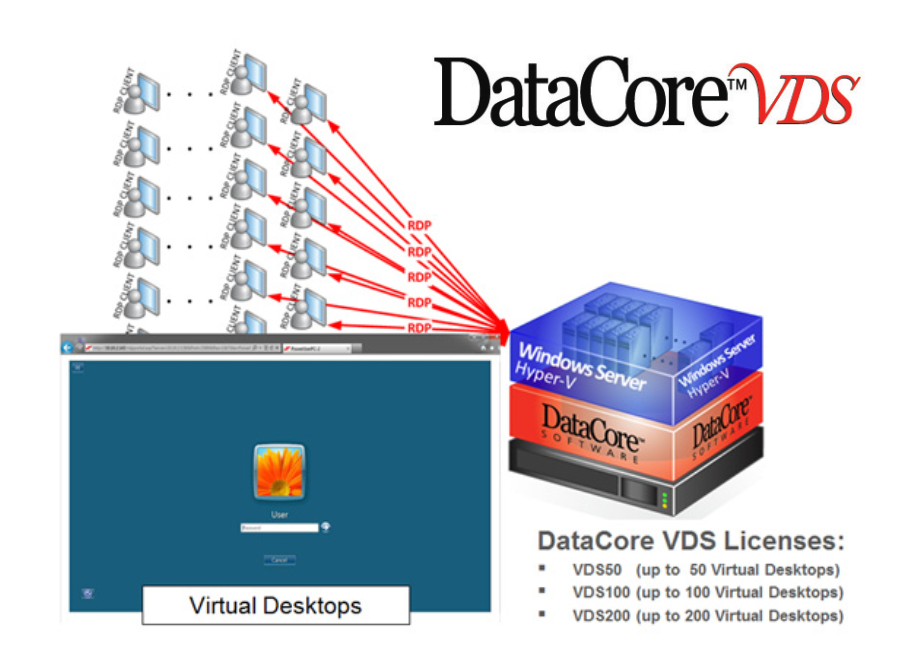
At last weeks’ DataCore Software Northern Europe Conference entitled ‘Optimising your Virtual Environment,’ DataCore Software, the premier provider of storage virtualisation software, along with DataCore solution providers and alliance partners, celebrated its 15th year anniversary and introduced to a packed auditorium, the new DataCore VDS (Virtual Desktop Server) software platform to Northern European customers in search of simple, affordable VDI solutions for small to mid-size businesses.
DataCore Introduces a New Software Product line: DataCore VDS - The Virtual Desktop Server
The announcement encouraged immediate positive uptake from the 100+ attendees keen to find out more about the potential impact of the announcement to their portfolio and environment.
One of the top DataCore R&D Directors took delegates through how DataCore VDS is designed to cost-effectively deploy and serve virtual desktops. DataCore VDS is a VDI (Virtual Desktop Infrastructure) application-specific use case that optimally applies DataCore’s architectural advantages to make it practical to deploy persistent 'stateful' virtual desktops at a lower cost and higher performance than alternatives.
DataCore VDS: A Powerful ‘Stateful’ Virtual Desktop Solution
True virtual desktops are ‘stateful’ (or persistent), they deliver a similar user experience as if a user is on a physical desktop or laptop PC. With ‘stateful’ virtual desktops, an end-user is assigned a virtual machine for their own use to run applications, to browse, to do downloads. Turn the virtual desktop off and then back on and it retains the ‘State’ of what you were doing, it is just like when you close and open a laptop.
DataCore VDS addresses unfulfilled SMB market demand for cost-effective solutions
Small and medium businesses want to adopt desktop virtualisation for the same reasons large enterprises do – to reduce desktop management costs, improve productivity and increase business agility, but they often find enterprise-class solutions overkill for smaller environments.
Unlike VDI offerings aimed at ‘Big Companies’ on the market which are complex and require many 1000’s of desktops to justify the high costs involved, DataCore VDS dramatically lowers the complexity and significantly reduces the cost per VDI instance. The solution is priced and sized for small, medium size businesses and departmental users. DataCore VDS addresses this unfulfilled market demand with cost-effective and simple to use solutions specifically designed to meet the budgets and needs of 50 to 200 virtual desktop deployments. Most importantly, DataCore VDS makes it economically possible to not sacrifice performance and have a ‘true’ desktop user experience.
The Ultimate Objective: A Great User Experience
Other VDI approaches tend to be complex, costly and inefficient. Also, they are difficult to install and manage. While the ultimate objective is to provide users with a virtual desktop that performs and works as well or better than a physical computer, this objective is the first to be sacrificed due to the high costs needed to achieve the ‘true’ desktop experience and responsiveness that end-users expect.  Storage has been the major barrier and cost factor; current VDI approaches have had to use expensive storage networks, enterprise storage arrays, fast disks, SSDs and shared storage to achieve needed performance. However the economics do not make sense.  The cost of storage has limited VDI deployments only to large companies with big budgets.  All the above arguments together dictate the need for a new approach to address the storage cost and performance challenges.
DataCore VDS Compelling Benefits
DataCore VDS is the easy and affordable virtual desktop solution designed for SMBs. It deploys on a single server, and includes the tools Windows® administrators need to rapidly deliver centrally-managed virtual desktops to any user for less than the cost of new PCs.
The DataCore VDS highly efficient architecture eliminates up to 75 percent of VDI costs without compromising performance and most importantly the user experience. DataCore VDS is:
Simple and Fast to Install, Administer and Use
  • Runs on off-the-shelf servers; any storage
  • Intuitive and easy for administrators to use
Affordable and Super Storage Efficient
  • Uses a fraction of storage compared to other VDI architectures
A High Performance Optimized Architecture
  • Delivers ‘Best in Class’ price performance
  • Optimally manages I/O traffic and caches to achieve high performance
A Powerful ‘Stateful’ Virtual Desktop Computing Solution
  • True Desktop computing. What users expect!
DataCore is focused on solving storage problems and VDI is storage challenged
“We are not moving away from our core business, we are doing what we do best. DataCore VDS is fundamentally a storage solution that leverages Microsoft virtualisation capabilities and DataCore’s powerful architectural advantages to makes VDI practical and affordable,” states George Teixeira, CEO and President, DataCore Software.
Product Pricing, Roll Out and Availability
DataCore VDS will be released this month in Germany & UK where select partners have already been trained. In Q2, the solution will be made available exclusively in Europe through DataCore’s established network of trained and authorized EMEA based solution providers.
Pricing starts at under EURO 4.600 for a DataCore VDS software license able to support 50 virtual desktops.
Also announced at the conference, Simon Birbeck, Waterstons, is awarded DataCore Master Certified Engineer status elevating him to the ranks of elite engineers for the most complex environments.

Tuesday, 26 March 2013

Harvest The Benefits Of Storage Virtualization; IT departments that don't are wasting money


IT departments that do not enthusiastically embrace storage virtualization are essentially wasting money.

By Mark Peters, ESG Senior Storage Analyst

At a recent industry conference, a senior manager from a very sizeable IT organization took me to one side to ask -- quietly! -- whether I thought thin provisioning "is okay? It safe to try?" Really? Maybe you're surprised -- but I can tell you that every time we research such tools at ESG we are amazed at how far the adoption (perhaps I should say "active use") is behind what operational and financial logic would seem to dictate.
Read the full article at:
URL: http://www.informationweek.com/harvest-the-benefits-of-storage-virtuali/240151123
Highlights:

Harvesting The Benefits of Storage Virtualization

Storage virtualization offers benefits to the storage infrastructure that are similar to those that server virtualization delivers on the compute side. In other words, storage virtualization is breaking the mold so that the true value of data services is no longer limited by hardware characteristics. Instead of dedicated pools of storage capacity that cannot be shared, a virtualized storage pool can enable:

-- Reclamation of stranded storage capacity: This makes unused capacity available to any servers, users or applications accessing the (now) general pool. In addition, when storage is no longer needed, it becomes part of the pool again and can be used elsewhere.

-- Consolidated storage management: Applying to all storage resources, this can eliminate multiple tools and processes for different types of storage arrays and media. Consolidating storage management under one umbrella makes the environment easier to manage and provides less opportunity for both human and administrative errors.

-- Advanced storage management features: These can extend the useful life of storage devices, as well as maximize the return on investment and potentially prevent, or at least delay, additional storage purchases. For example, in a virtualized storage environment, functions such as snapshots, remote replication and thin provisioning, which may come bundled with a storage system, can be shared across arrays that don't have those features.

-- More energy-efficient operations: This can be achieved by using storage virtualization to improve disk utilization, which in turn reduces the number of physical machines while simultaneously reducing data center floor space, power and cooling requirements.

-- Non-disruptive data migration: While data migration is a core concept in executing a pragmatic and sensible tiered storage strategy, it has also long been seen as one of the most common and disruptive storage tasks. In traditional storage environments, it's not at all uncommon for users to decide that the pain is enough to prevent them from enjoying the gain! But with storage virtualization, data can be moved non-disruptively (and often even automatically) between storage tiers, further optimizing hardware infrastructure costs.

-- Reduced capital expense and total cost of ownership for storage: This is all-but guaranteed with the implementation of storage virtualization. A virtualized storage environment replaces the fragmented, dedicated DAS, SAN and NAS topologies (which -- in traditional storage worlds -- invariably operate with separate storage resources and often a unique set of management tools) with a centralized and more flexible storage pool.

Virtualized storage is essentially accomplished in the same way as the virtualization of servers: The physical controller hardware and disk resources are logically separated from the data services. With virtualized storage, a pool of flexible, consolidated resources with a common management interface is built using capacity from multiple arrays that can have different specifications and software features, and may even have come from different vendors. Because storage is not dedicated to any specific server or application, it creates a much more flexible and responsive environment while also permitting increased utilization rates.

In addition, while users may be able (using VMware vMotion or some such tool) to move a running application between servers, traditional, fixed storage won't automatically go along with the change, thus rendering it all-but pointless. Virtualizing the computing element without virtualizing the storage as well precludes the complete agility and true utility-like resource provisioning that most IT shops are looking for; if the storage cannot match what the servers can do, then the anticipated service levels cannot be met.

The economic and operational value of virtualizing storage is clear. For decades, most organizations have had a fairly cavalier attitude towards storage. It's not that IT wasn't aware of its rising costs -- it's more that it didn't see any other ways to address the problems with which it was faced. But virtualization has changed all that, demonstrating a way to operate with greater efficiency. Users that do not enthusiastically embrace it are essentially wasting money, while at the same time missing out on operational improvements that can only be gained in fully virtualized environments.
It's worth a few minutes to check that you're maximizing your potential storage virtualization benefits and not falling into the adoption gap.

Monday, 25 March 2013

Thanks for a Great DataCore Customer and Partner Event, DataCore Celebrates 15 Year Anniversary and Introduces DataCore VDS to Meet UK/Nordics Demand for Affordable SMB Virtual Desktop Solutions

DataCore Northern European Customer & Partner Conference 2013
DataCore Customer Event Celebrates 15 Year Anniversary and Introduces DataCore VDS to Meet UK & Nordic Demand for Affordable SMB Virtual Desktop Solutions

Thanks all for a super event last week, hosted in downtown London at the ME/Melia Hotel. It was great to see over 100 attendees and have a chance to hear customer presentations, get a preview on DataCore VDS (Virtual Desktop Server) available in April 2013 and to hear the latest features on the DataCore roadmap.

To review the latest DataCore VDS information, please visit: http://www.datacore.com/VDS.aspx
or learn more by downloading these documents:
Announcement Release
DataCore VDS Solution Brief
DataCore VDS Powerpoint Presentation
DataCore VDS Technical Design Guidelines

Key Presentations:
Bjarne Poulsen, Managing Sales Director for Northern Europe kicked off the event.
At the event, the Keynote on 'Software-defined Storage' was presented by DataCore CEO, George Teixeira.
George Dochev, a technical leader that has been with DataCore for 15 years presented the DataCore roadmap for 2013.

Featured Customer Presentation - Open University
Open University, ICT and System Manger Paul Alexander presented their Virtual IT environment and spoke to how DataCore is the virtual foundation of their infrastructure.


Also at the event, we had a number of alliance partner that presented the value of combined solutions with DataCore.
DataCore London Customer Event Alliance Partners:  


Wednesday, 6 March 2013

CeBIT 2013: DataCore Showcases SANsymphony-V Advances and Introduces DataCore VDS Exclusively in Europe to Meet Channel Demand for Affordable SMB Virtual Desktop Solutions

 
At CeBIT 2013 (Hanover, Germany (March 5th – 9th) DataCore Software, the premier provider of storage virtualization software, is showcasing the latest advances in its SANsymphony™-V Storage Hypervisor and introducing the new DataCore VDS (Virtual Desktop Server) software platform to European solution providers in search of simple, affordable VDI solutions to target the large base of small to mid-size businesses.

DataCore Showcases SANsymphony-V Storage Hypervisor Advances
At the “Virtualization & Storage Forum” (Hall 2, Stand A40), organized by DataCore’s distribution partner Arrow ECS and CeBIT, DataCore is presenting its latest SANsymphony-V performance acceleration and auto-tiering enhancements, more powerful CDP capabilities, greater scalability, support for Windows Server 2012 and highly optimized integration of Flash-based storage to dramatically speed up mission-critical tier-1 applications. For more information read here.


DataCore Introduces a New Software Product line: DataCore VDS - The Virtual Desktop Server
DataCore VDS is designed to cost-effectively deploy and serve virtual desktops. DataCore VDS is a VDI (Virtual Desktop Infrastructure) application-specific use case that optimally applies DataCore’s architectural advantages to make it practical to deploy persistent 'stateful' virtual desktops at a lower cost and higher performance than alternatives.

DataCore VDS: A Powerful ‘Stateful’ Virtual Desktop Solution
True virtual desktops are ‘stateful’ (or persistent), they deliver a similar user experience as if a user is on a physical desktop or laptop PC. With ‘stateful’ virtual desktops an end-user is assigned a virtual machine for their own use to run applications, to browse, to do downloads. Turn the virtual desktop off and then back on and it retains the ‘State’ of what you were doing, it is just like when you close and open a laptop.

DataCore VDS addresses unfulfilled SMB market demand for cost-effective solutions
Small and medium businesses want to adopt desktop virtualization for the same reasons large enterprises do – to reduce desktop management costs, improve productivity and increase business agility, but they often find enterprise-class solutions overkill for smaller environments.

Unlike VDI offerings aimed at ‘Big Companies’ on the market which are complex and require many 1000’s of desktops to justify the high costs involved, DataCore VDS dramatically lowers the complexity and significantly reduces the cost per VDI instance. The solution is priced and sized for small, medium size businesses and departmental users. DataCore VDS addresses this unfulfilled market demand with cost-effective and simple to use solutions specifically designed to meet the budgets and needs of 50 to 200 virtual desktop deployments. Most importantly, DataCore VDS makes economically possible to not sacrifice performance and a ‘true’ desktop user experience.

The Ultimate Objective: A Great User Experience
Other VDI approaches tend to be complex, costly and inefficient. Also, they are difficult to install and manage. While the ultimate objective is to provide users with a virtual desktop that performs and works as well or better than a physical computer, this objective is the first to be sacrificed due to the high costs needed to achieve the ‘true’ desktop experience and responsiveness that end-users expect. Storage has been the major barrier and cost factor; current VDI approaches have had to use expensive storage networks, enterprise storage arrays, fast disks, SSDs and shared storage to achieve needed performance. However the economics do not make sense. The cost of storage has limited VDI deployments only to large companies with big budgets. All the above arguments together dictate the need for a new approach to address the storage cost and performance challenges.

DataCore VDS Compelling Benefits
DataCore VDS is the easy and affordable virtual desktop solution designed for SMBs. It deploys on a single server, and includes the tools Windows® administrators need to rapidly deliver centrally-managed virtual desktops to any user for less than the cost of new PCs.

The DataCore VDS highly efficient architecture eliminates up to 75 percent of VDI costs without compromising performance and most importantly the user experience. DataCore VDS is:

  • Simple and Fast to Install, Administer and Use
    - Runs on off-the-shelf servers; any storage
    - Intuitive and easy for administrators to use
  • Affordable and Super Storage Efficient
    - Uses a fraction of storage compared to other VDI architectures
  • A High Performance Optimized Architecture
    - Delivers ‘Best in Class’ price performance
    - Optimally manages I/O traffic and caches to achieve high performance
  • A Powerful ‘Stateful’ Virtual Desktop Computing Solution
    - True Desktop computing. What users expect!

"DataCore VDS addresses a major new business market opportunity, and for us, it is a real "sweet spot". It allows us to deliver simple and affordable VDI solutions well matched for 50 to 200 virtual desktop environments. Unlike highly complex VDI solutions that may be cost-effective for very large 1000 or more desktop projects, DataCore VDS removes many implementation barriers and greatly reduces the cost per virtual desktop instance,” says Jürgen Thurau, Senior Consultant at DataCore partner IT-On.NET GmbH. “Small and medium enterprises can finally operate a virtual desktop infrastructure economically to improve productivity and reduce costs. We are extremely optimistic and ready to work with the DataCore to establish DataCore VDS solution successfully in the marketplace.”

DataCore is focused on solving storage problems and VDI is storage challenged
“We are not moving away from our core business, we are doing what we do best. DataCore VDS is fundamentally a storage solution that leverages Microsoft virtualization capabilities and DataCore’s powerful architectural advantages to makes VDI practical and affordable,” states George Teixeira, CEO and President, DataCore Software.

Product Pricing, Roll Out and Availability
DataCore VDS will be released in April in Europe where select partners have already been trained. The solution will be made available during Q2 exclusively in Europe through DataCore’s established network of trained and authorized EMEA based solution providers.

Pricing starts at under EURO 4.600 for a DataCore VDS software license able to support 50 virtual desktops.

Monday, 25 February 2013

DataCore Ramps Up Database Performance in a Virtualization World

Virtualize Business Applications

Original Article from: Database Trends and Applications

DataCore Software, a leading provider of storage virtualization software, has made enhancements to its SANsymphony-V Storage Hypervisor. The new capabilities are intended to support customers who are facing high data growth, as well as the need to enable faster response times and provide continuous availability for Tier 1 business-critical applications.

“This is all about customers who are virtualizing their large database systems – whether it is Oracle RAC, SAP, or SQL Server – that class of applications,” Augie Gonzalez, director of product marketing at DataCore, tells 5 Minute Briefing. According to Gonzalez, often when these organizations virtualize their applications they run into some unexpected performance degradation. "Much of what we are doing in this release of the SANsymphony-V goes right at those issues.”

Improving scalability, DataCore gives customers the ability to choose and define cost-effective nodes, and with the enhanced SANsymphony-V, the maximum number of storage virtualization nodes in a centrally managed group doubles from four to eight. This enables both very large scale data centers and cloud service providers to expand into the additional nodes, extending capacity, throughput and connectivity. “The improved scalability is sometimes not used strictly because they need the capacity but also in order to assure resiliency and to avoid the performance hit when a component is lost in the architecture,” observes Gonzalez.

In addition, SANsymphony-V maximizes existing resources, while incorporating the latest technologies like Flash and solid state disks (SSDs) cost effectively. “We have found that the way Flash and SSDs behave as storage devices is a little bit different and little more nuanced from the way that hard disk drives operate and so we have done some special optimizations to account for the way that they absorb data in a ‘bursty’ manner.” With this release, SANsymphony-V accounts for that characteristic so the end user at the application level does not see the downstream behavior and sees continuous smooth operations.


Blog image

SANsymphony-V also enables trend analysis over time with a recording feature that compiles and displays a running chart of metrics gathered from the environment. “For a long time we have had real-time visibility into the systems and that is good if you are keeping an eye on them. What we are doing in this case is enhancing that with trend analysis so that you can look over days, several weeks or a year and see where you are experiencing spikes in terms of users coming on or additional loads that are being submitted into the system. This enables you to look at the downstream consequences of those spikes and see if they require any additional resource to be put in place or better balancing of the resources that you have.” The historical collection may be exported as a CSV file for further analysis, planning and reporting with Microsoft Excel and other tools.


Additional capabilities include customized control for better resource utilization and storage tiering; and a greater degree of continuous data protection (CDP) as well as near-instant restoration for business-critical applications. SANsymphony-V also now runs on the Windows Server 2012 operating system in addition to Windows Server 2008 R2.

Complete information is available about SANsymphony-V Storage Hypervisor.


Wednesday, 20 February 2013

Overview Blog post on Performance Monitoring, Storage Profiles, CDP and Faster Performance in DataCore SANsymphony-V – PSP2 update

DataCore released the second product service pack (PSP) for their SANsymphony-V 9.0. The new PSP contains several fixes to further enhance stability and reliability as well as a number of new features. In this post I’d like to introduce you to the new or enhanced features.

To read the full post, visit: http://vtricks.com/?p=491


Performance Recording
Until now there was no possibility to record any performance statistics. You were only able to follow the performance data in a live session. But now they’ve added the possibility to record all statics. To save the data a SQL express instance, which was introduced with SSV 9.0, is used... http://vtricks.com/?p=491

Tuesday, 19 February 2013

DataCore Ramps Up Database Virtualization

http://www.dbta.com/Articles/ReadArticle.aspx?ArticleID=87779&utm_source=dlvr.it&utm_medium=twitter&utm_campaign=itiroundup

DataCore Software, a provider of storage virtualization software, has made enhancements to its SANsymphony-V Storage Hypervisor. The new capabilities are intended to support customers who are facing high data growth, as well as the need to enable faster response times and provide continuous availability for business-critical applications.

“This is all about customers who are virtualizing their large database systems – whether it is Oracle RAC, SAP, or SQL Server – that class of applications,” Augie Gonzalez, director of product marketing at DataCore, tells 5 Minute Briefing. According to Gonzalez, often when these organizations virtualize their applications they run into some unexpected performance degradation. "Much of what we are doing in this release of the SANsymphony-V goes right at those issues.”

Improving scalability, DataCore gives customers the ability to choose and define cost-effective nodes, and with the enhanced SANsymphony-V, the maximum number of storage virtualization nodes in a centrally managed group doubles from four to eight. This enables both very large scale data centers and cloud service providers to expand into the additional nodes, extending capacity, throughput and connectivity. “The improved scalability is sometimes not used strictly because they need the capacity but also in order to assure resiliency and to avoid the performance hit when a component is lost in the architecture,” observes Gonzalez.

In addition, SANsymphony-V maximizes existing resources, while incorporating the latest technologies like Flash and solid state disks (SSDs) cost effectively. “We have found that the way Flash and SSDs behave as storage devices is a little bit different and little more nuanced from the way that hard disk drives operate and so we have done some special optimizations to account for the way that they absorb data in a ‘bursty’ manner.” With this release, SANsymphony-V accounts for that characteristic so the end user at the application level does not see the downstream behavior and sees continuous smooth operations.

SANsymphony-V also enables trend analysis over time with a recording feature that compiles and displays a running chart of metrics gathered from the environment. “For a long time we have had real-time visibility into the systems and that is good if you are keeping an eye on them. What we are doing in this case is enhancing that with trend analysis so that you can look over days, several weeks or a year and see where you are experiencing spikes in terms of users coming on or additional loads that are being submitted into the system. This enables you to look at the downstream consequences of those spikes and see if they require any additional resource to be put in place or better balancing of the resources that you have.” The historical collection may be exported as a CSV file for further analysis, planning and reporting with Microsoft Excel and other tools.

Additional capabilities include customized control for better resource utilization and storage tiering; and a greater degree of continuous data protection (CDP) as well as near-instant restoration for business-critical applications. SANsymphony-V also now runs on the Windows Server 2012 operating system in addition to Windows Server 2008 R2.

Complete information is available about SANsymphony-V Storage Hypervisor.