Translate

Wednesday, 10 December 2014

SearchVirtualStorage: DataCore boosts performance, adds Storage Accelerator and QoS to SANsymphony-V10 and Virtual SAN

DataCore Software's SANsymphony-V10 now features a random write accelerator to improve performance of write-intensive workloads.
DataCore Software Corp. updated its SANsymphony-V10 storage virtualization software to boost performance and scalability, add quality of service capabilities and provide tighter integration with Microsoft Azure cloud services.
...The DataCore software runs on standard x86 servers and manages the capacity of their internal disk and/or solid-state drives (SSDs) as a shared storage pool.
One of the key features in the SANsymphony-V10 PSP1 update is the random write accelerator. DataCore said the new technology converts random writes into sequential writes to improve the performance of write-intensive workloads such as databases, ERP and online transaction processing systems, and workloads that use RAID 5 data protection.
Jon Toigo, CEO and managing principal at Toigo Partners International LLC, said DataCore could also position the random write accelerator to address the performance-degrading I/O blender phenomenon. The I/O blender effect occurs when multiple virtual machines try to write data at the same time.
"It's basically doing some log-file structuring and some write coalescence that turns a whole bunch of random writes into sequential writes so that you speed up the performance of your storage," said Toigo, who is a user of DataCore software.
Updates boost performance, management
Augie Gonzalez, director of product marketing at DataCore, said Iometer testing of 100% random write workloads with a 4K block size showed 33 times faster performance, with low-cost SATA hard disk drives (HDDs) running on Dell servers. According to Gonzalez, using identical test conditions, the random-write-accelerated SATA HDDs outperformed multi-level cell (MLC) SSDs that did not use the new "turbo charger" feature.
Gonzalez said, when using the random write accelerator, the SSDs also saw performance 3.6 times faster than without the write accelerator. The acceleration technology, coupled with the product's caching mechanism, also helps to reduce the write-induced wear-out factor of SSDs, he said.
SANsymphony-V10 PSP1 increases the maximum number of server nodes supported in hyper-converged configurations from 32 to 64. That allows customers to spread workloads across more servers in a cluster to boost throughput. The company said each server can support more than 1 million IOPS, and the extra scalability can be especially helpful with distributed latency-sensitive applications and large virtual desktop infrastructure (VDI) deployments.
"Let's say the production cluster is running out of space," Gonzalez said. "Before this customer can stand up another server and put more storage on it, they've got to get over this afternoon's processing window. Their test and dev cluster has extra space. Normally those two couldn't touch each other. In the case of DataCore, having a common storage pool, we can basically loan that production cluster some temporary capacity."
SANsymphony-V10 PSP1 also introduces quality of service (QoS) controls to enable customers to manage and regulate the system to ensure that low-priority workloads don't monopolize resources that more critical applications need. The new release features host group access control to let administrators assign different application hosts to different segments of the storage pool.
"The combination allows you to segregate local partitions of the data to where you need it but also to remap it when you need to," DataCore CEOGeorge Teixeira said.
Gonzalez noted that DataCore's QoS applies not only to capacity but also to Fibre Channel and iSCSI connections with the host. With PSP1, the company has added utilization tracking capabilities and chargeback reports to enable customers to manage their storage infrastructure as a private cloud.
Another new option in SANsymphony-V10 is the ability to have a standby node to enable full performance during software updates, equipment refreshes and maintenance tasks or to offload responsibilities from an overtaxed node. The product already supported automatic failover between nodes in the event of a storage or device failure, but there was a performance impact. DataCore customers will now have the option to shift workloads to a standby node without disrupting the applications or degrading performance and throughput.
Teixeira said the standby node will be especially helpful for customers such as banks or hospitals that use metro clusters or metro mirroring stretching across different locations. While this type of feature traditionally appeals to customers with no tolerance for failure, and who are willing to pay for an extra server to get an even higher level of availability, falling server prices could bring it to more midmarket IT organizations.
DataCore looks to public cloud for backup and DR
With the PSP1 update, DataCore also gives customers additional options to send data to public cloud storage for off-site backups, archives and disaster recovery. The company tightly integrated and certified its SANsymphony-V10 to work with on-premises Microsoft StorSimple hybrid cloud arrays, which can serve as a bridge to Microsoft's Azure public cloud storage.
"One of the advantages we bring to Microsoft is that their array only works with iSCSI storage," Teixeira said. "We work with both Fibre Channel and iSCSI, so we can virtualize all the storage on-premises, whether it is Fibre Channel or iSCSI based, and we can automatically tier and migrate it to the StorSimple gateway."
...Teixeira said he is especially focused on Windows Azure because the service caters to business use involving databases such as Microsoft SQL Server and Exchange Server.
"When we talk to our customers, what they're looking for is a rock-solid commercial capability out there, and Windows Azure seems to be that platform for most of them," Teixeira said. "So, getting it jointly certified was key for us. I think it's probably where we're going to see the most pickup from our customer base."
See Full Article at: http://searchvirtualstorage.techtarget.com/news/2240234858/DataCore-boosts-performance-adds-QoS-to-SANsymphony-V10 

Tuesday, 9 December 2014

Regent’s University London Relies on DataCore Software-defined Storage across Multiple Sites Campus-wide

UK Software-Defined Storage Customer Testimonials Span Any Hypervisor, Any Storage, Any Location 

DataCore, a leader in software-defined storage and Datashare Solutions,(Shift F7 Group) a DataCore go-to partner, are highlighting the momentum in the UK towards adoption of software defined-storage (SDS) solutions. Datashare Solutions has compiled a testimonial briefing pack outlining key buying criteria and customer adoption reasons.  


“The DataCore solution with Nexsan storage allowed us to increase flexibility on existing infrastructure and benefit fully from the investment we had already made in our data centres and VDI solution” Carlos Nogueira, Head of ITS, Regents University
Company: Regent’s University – Needed a Cost Effective, Resilient, Replication solution for NetApp Filer and Auto Tiering for VDI workload balancing.

The University had invested heavily and commissioned two data centres within their campus and were looking for a solution that would increase resiliency through replication between different storage vendors. They also required extra storage capacity for VDI and other solutions they were deploying. Datashare Solutions (Shift F7 Group) installed a DataCore mirrored system backed by Nexsan storage to replicate data resident on their existing NetApp Filer. This was achieved, maintaining levels of resiliency and much more cost effectively in comparison to an end-to-end NetApp solution. Datashare Solutions also deployed a VDI solution across the two data centres using application acceleration within the DataCore servers to achieve excellent levels of automated data tiering.
About Datashare Solutions (Shift F7 Group)  www.datasharesolutions.com.

Monday, 8 December 2014

Dermalogica, Business Continuity Assured with DataCore Software

UK Software-Defined Storage Customer Testimonials Span Any Hypervisor, Any Storage, Any Location 

DataCore, a leader in software-defined storage and Datashare Solutions,(Shift F7 Group) a DataCore go-to partner, are highlighting the momentum in the UK towards adoption of software defined-storage (SDS) solutions. Datashare Solutions has compiled a testimonial briefing pack outlining key buying criteria and customer adoption reasons...

“Ensuring that our business systems would not be affected whatever the circumstances was a key consideration. Datashare Solutions provided us with a solution from DataCore and Nexsan that guarantees just that.” Alan Norman, IT Manager UK, Dermalogica


Company: Dermalogica  - Business Continuity Assured:

Dermalogica, the leading professional UK skin care organisation, required assurances that their critical business systems and corporate communication platform was both highly fault tolerant and offered increased resiliency.  Datashare Solutions (Shift F7 Group) introduced DataCore’s SANsymphony platform, which together with Nexsan storage and the fault resilient features of the VMware hypervisor, allows Dermalogica to enjoy consistent system and storage redundancy throughout the entire network.


About Datashare Solutions (Shift F7 Group)  www.datasharesolutions.com.

Friday, 5 December 2014

One of the UK’s top legal practices Payne Hicks Beach Relies on DataCore Software-defined Storage for Multi-site Metro Distance DR and Uptime for Critical Apps

UK Software-Defined Storage Customer Testimonials Span Any Hypervisor, Any Storage, Any Location 

DataCore, a leader in software-defined storage and Datashare Solutions,(Shift F7 Group) a DataCore go-to partner, are highlighting the momentum in the UK towards adoption of software defined-storage (SDS) solutions. Datashare Solutions has compiled a testimonial briefing pack outlining key buying criteria and customer adoption reasons.  

Example:
“The ROI has been fantastic with DataCore. It has run to the point where performance has never been an issue and without any unplanned downtime for more than 6 years”. Michael Leedham, IT Manager, Paynes Hicks Beach
Legal Firm Payne Hicks Beach – Needed Disaster Recovery and Zero Downtime of Critical Apps:Synonymous with quality and one of the UK’s top legal practices based in Lincoln’s Inn, Payne Hicks Beach (PHB) required a system to support the processing of critical applications along with fault tolerant split clustering between two of their offices. Today, the Firm is able to withstand the failure of an entire building with a synchronous mirror of data and systems created between their locations utilising DataCore and VMware’s VSphere 4.x. Applications are accessed and available 24 x 7, with no downtime tolerated for upgrades.

Thursday, 4 December 2014

A2 Dominion Housing Group - Performance Improvements of Critical Apps with DataCore Software-defined Storage

UK Software-Defined Storage Customer Endorsements Span Any Hypervisor, Any Storage, Any Location 

DataCore, a leader in software-defined storage and Datashare Solutions,(Shift F7 Group) a DataCore go-to partner, are highlighting the momentum in the UK towards adoption of software defined-storage (SDS) solutions. Datashare Solutions has compiled a testimonial briefing pack outlining key buying criteria and customer adoption reasons.  

Shift F7 Group Marketing Manager, Sue Beckwith, explains more, “It’s been refreshing to compile this testimonial document as it really brings the ‘software defined’ experience to life. SDS has been much hyped of late, but as you can see from our customer endorsements, we have been successfully implementing DataCore’s software abstraction layer across any storage and on any hypervisor for many years now. It truly and flexibly stands the test of time.”
Example:
Company: A2 Dominion Housing Group - Performance Improvements of Critical Apps:
When one of the UK’s leading Housing Associations’, A2Dominion Housing Group, had a requirement to increase the performance of their core housing application and improve the recovery capabilities for the application in the event of a disaster, they engaged with Datashare Solutions for a solution. Their existing SAN was not able to deal with the high I/Os from replication and suffered a significant number of cache misses with an adverse effect on the performance of their critical applications for the users.
The existing hardware based SAN seemingly offered enough spindles for adequate disk performance, good capacity and RAID resiliency but was unable to cope with the load placed on it by the users. Installing DataCore SANsymphony software based storage, enabled the organisation to significantly increase their cache hits; increase server RAM and add a layer of high performance SSD. The solution also enabled near synchronous replication between A2Dominion’s primary and backup data centres, significantly reducing their RTO.
“There has been a marked improvement in application performance since the implementation – we were very impressed with the fact that we could improve performance and our recovery objectives with DataCore” Mark Prosser, Head of Service Delivery, A2 Dominion Housing Group
About Datashare Solutions (Shift F7 Group)Datashare Solutions are a DataCore Silver Solution provider. As part of the Shift F7 Group, they provide independent, expert advice on the most appropriate client, server, network, storage, business telephony and software solutions including hosted and managed services from our ISO27001 data centre. We maintain high level accreditations from the major IT manufacturers and robust service level agreements for our managed services. www.datasharesolutions.com.

Tuesday, 2 December 2014

Datacentre Solutions: One of the world’s largest online gaming companies NetEnt turns to DataCore’s software defined storage

NetEnt realises the business value of DataCore’s Software-Defined Storage

One of the world’s largest online gaming companies turns to DataCore’s software defined storage, SANsymphony-V.
 
Europe’s largest gaming company, NetEnt uses DataCore’s SANsymphony-V software-defined storage platform to safeguard it’s customer data and add the needed flexibility and cost efficiencies to deal with high data growth rates of over 30% quarter on quarter. NetEnt operates in one of Europe’s most dynamic, intensely regulated and competitive business sectors. Today, DataCore enables NetEnt’s business to meet its business continuance objectives; to prevent storage from disrupting critical applications and to work across heterogeneous systems and diverse legal requirements. This enablement allows NetEnt to perform its business and support over 16 billion transactions a year.
NetEnt Live Roulette
As a premium supplier of online casino games, NetEnt services’ are used by many of the world’s most successful online casino operators. NetEnt operates its business from several data centres across the globe, including the company’s primary data centre in Malta. Supporting a vast degree of varying sized customers, with different cross-border compliance regulations, NetEnt’s Infrastructure Architect, Anders Redaner faces a 24x7x365 global challenge to ensure zero downtime in a highly performant infrastructure:

Business Continuity: Software-defined Storage Eliminates Single Points of Failure
“100% safety of customer data and high availability 24/7 of hosted services has always been our top priority. In our previous hardware based environment, we had identified potential single points of failure using our existing high capacity storage arrays operating as isolated islands which we needed to address and federate.”
It was the support and management of different models of hardware used for different customer scenarios that caused NetEnt to spend too much time on migrating customer systems between arrays. Firmware upgrades could not be guaranteed with 100% data security and availability, also performance and capacity issues proved to be inflexible, hard to solve and costly to fix.

DataCore SANsymphony-V: A Comprehensive Solution
A fundamental overhaul of the storage architecture was needed to provide 100% customer data security and high availability with no risk of data loss; increased flexibility for storage performance and capacity management, today and in the future, and better cost efficiency. NetEnt evaluated several storage solutions proposed by vendors like HP, IBM, HDS, NetApp, EMC and others. But what they could not pin-point was a vendor who could bring one comprehensive solution that offered both future scalability and the flexibility to accommodate the diverse needs and differing sizes of different Casino platforms.

NetEnt was initially introduced to DataCore at an industry event where it learned about its pure Software-defined Storage approach. A detailed proof of concept process was soon started to test the stability, performance and functionality of SANsymphony-V. Anders details the journey to DataCore within NetEnt:

“Amongst all well-known storage vendors, there was no real encompassing solution until we evaluated DataCore’s SANsymphony-V software. DataCore’s Software-defined Storage platform gives NetEnt all the storage flexibility, high availability, performance and functionality required and improves our overall data security with an adaptable design for future requirements, which is a key priority for us”

Simple and Non-disruptive Migrations with SANsymphony-V
Procurement of new hardware also occurred. Hitachi Data Systems (HDS) were bought to replace legacy HP storage, but the purchase came with a welcome increase in performance and a lowering of the cost of storage hardware. This was possible since the fully agnostic SANsymphony-V software layer enabled the systems to be migrated without disruption and added performance acceleration to the entire storage infrastructure.
Anders comments: “With DataCore, we are free of a hardware vendor lock-in and migration from one platform to the next is easy.”

Worldwide today, 14 SANsymphony-V nodes have been deployed running on HP Proliant servers, each equipped with 256 GB RAM and DataCore’s high speed caching. DataCore now virtualises, pools and optimises the HDS storage hardware and centrally manages all storage from the DataCore Software-defined storage platform. Over 400 TB and 1500 virtual machines are now supported by the DataCore infrastructure. The SANsymphony-V architecture provides high availability and performance for the CasinoModule™ production systems backed with underlying Microsoft SQL data bases and systems under Windows, Linux and VMware. For total resilience, SANsymphony-V is used to synchronous mirror production data and safeguard it between data centres worldwide and within separate fire proof sections inside individual data centres, safely securing the core business of over 16 billion transactions, each year.

“The combination of DataCore SANsymphonyV with dual HDS Arrays gives NetEnt a very secure and highly available solution that can handle the company’s current and future requirements through its flexible topology. We have achieved full redundancy independent from storage systems and gained the flexibility to scale, migrate or change the hardware exactly to our needs.” reflects Anders Redander.

Software Flexibility to Meet Future business Needs and Changing Legal Regulations
NetEnt summarized their strategic targets and how they were achieved through DataCore’s SANsymphony-V Software-Defined Storage approach by volunteering to present their SDS experience independently to European audiences at this year’s IP Expo Europe (London, 8/9 Oct 2014). <>. Anders concluded that his customer data is safe and sound. Storage failures no longer impact critical applications and 100% high availability is now achieved by removing all single points of logical and physical failures. Now fully enabled with a more flexible storage infrastructure solution, NetEnt has significantly reduced its workload and management overheads, enabled non-disruptive updates, changes and migrations by utilising an adaptable design that improves productivity and accommodates changes brought on by future regulations. Costs have been regulated and whether servicing large data centres or smaller installations, the benefits are equally reaped by both.


Read more: http://dcseurope.info/news_full.php?id=36225&title=NetEnt-realises-the-business-value-of-DataCore%92s-Software-Defined-Storage#ixzz3Kk3p9Ola

Monday, 1 December 2014

The Register: DataCore lifts baton, strikes up the 64th SANsymphony with latest update release for SANsymphony-V and Virtual SAN


Comment DataCore has updated its SANsymphony and Virtual SAN software products to reach 100 million IOPS and 64PB capacity. It's also getting into bed with Azure.

SANsymphony-V10 PSP1 builds a SAN from a cluster of servers, aggregating each server's storage into a central virtual pool. The company has built its product on virtual SAN technology which VMware has now blessed as a concept with its VSAN technology...
...DataCore says that - unlike VMware's ESXi-only VSAN - its Virtual SAN supports any hypervisor and any storage.


Its software enhancements mean the following things:
  • Systems can scale out to 64 nodes, up from 32
  • They can scale up to 64PB configurations
  • Notionally they can deliver more than 100 million IOPS
Claiming a 64PB and 100 million IOPS capability is bold; achieving it will be impressive.
The SANsymphony V10 PSP1 product has quality of service (QoS) features providing policies which manage access to storage tiers divided between on-premise and public clouds, defining storage resource allocation and providing Service Level Agreement capability. This ensures high priority applications aren't slowed by less important ones whose consumption of resources is controlled by capping their data transfer rate and IOPS.

DataCore says storage resources can be logically segregated, monitored and regulated on a departmental basis. This SW release also adds utilisation tracking capabilities and chargeback reports.
Random Write Accelerator technology has been added, which - DataCore says - benefits ERP, OLTP and database applications with up to 30 times faster writes. This secret sauce is said to provide a greater than 30x random write improvement on RAID-5 protected datasets with data and metadata - reconstruction information - spread across multiple locations on different disk drives.

It is also said to be especially effective with slower SATA disk drives exhibiting longer rotational and seek delays when updating data blocks. And flash can benefit too, with SSDs having lower write amplification and less wear, as well as a claimed 3.6x increase in IOPS.

This sound to us like some kind of random write buffering transforming many random writes into fewer sequential ones.
Doubling the node count in Virtual SANs helps increase the number of applications they support or the number of users in the VDI use case. DataCore says resources can be shared across multiple clusters as well.
There is zero-touch failover to provide non-disruptive failover if either a storage or server component fails. Internet mirrors can span 60-mile (100 kilometre) distances.

Microsoft Azure integration

SANsymphony-V can use Microsoft's Azure cloud core via a Microsoft StorSimple array with a very, very long name - the DataCore-ready certified Azure StorSimple Hybrid Cloud Storage Array.
In a hybrid cloud scheme Azure provides backend geo-redundant cloud storage, with SANsmphony-V auto-tiering on-premise storage to StorSimple Arrays and hence Azure. The StorSimple arrays can be pooled like any other SanSymphony storage.
Working set backups (snapshot copies) can be sent to Azure through the StorSimple gateways. They can be retrieved from separate locations by other StorSimple arrays or by Azure-hosted applications.
If accessing hosts use Fibre Channel, SANsymphony-V converts this protocol to iSCSI.

Bits and bobs

There's more; SANSymphony V10 PSP1 gets performance-monitoring capabilities, wizards to automate processes such as software updates, and enhanced CDP capabilities for restoring from known good points-in-time.
There is now a standby node capability whereby workloads can be redistributed when an existing node is taken out of service or gets overburdened in a SANsymphony-V group.
The latest Fujitsu PRIMERGY BX and CX servers are certified as DataCore Ready Software-defined Storage servers. Fujitsu's ETERNUS DX arrays have gained DataCore Ready Certification.
SANsymphony V10 PSP1 and VirtualSAN are shipping now with the enhancements above. DataCore's 10,000 customer sites should be pleased with this raft of new features as their mature product gets significantly extended. 

Wednesday, 26 November 2014

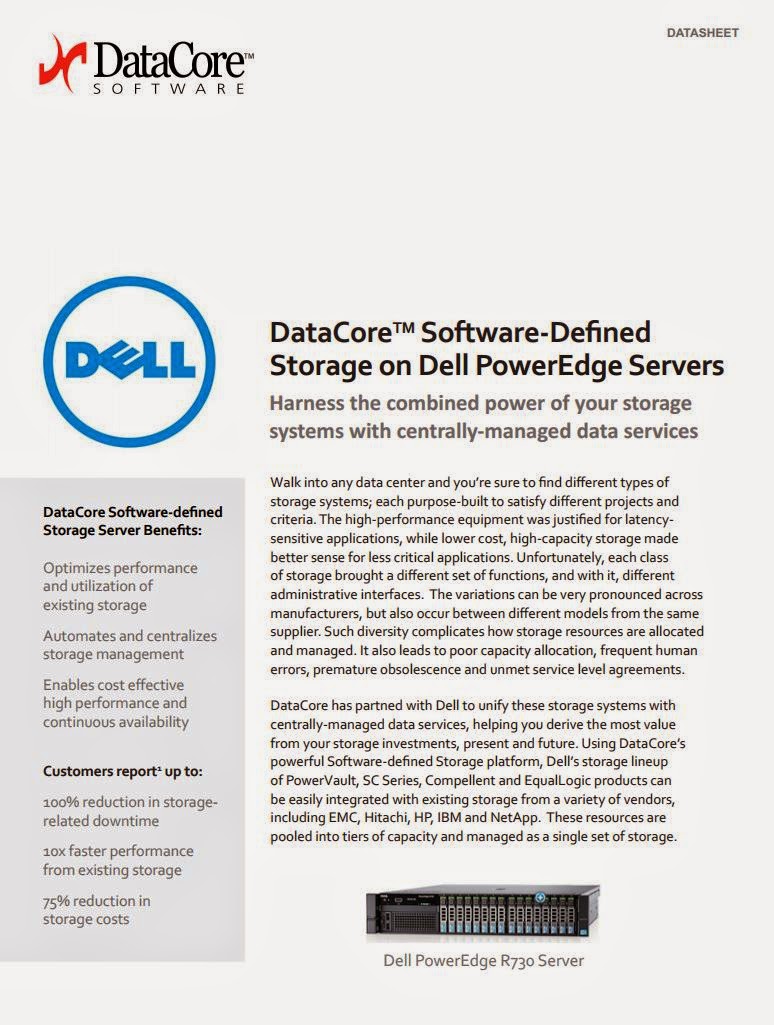
DataCore Offers Pre-Tested Software-defined Storage Solutions Based on Dell PowerEdge Servers and is Named a Certified Dell Technology Partner

http://www.it-director.com/channels/reseller/news_release.php?rel=44665

DataCore, a leader in software-defined storage and converged virtual SAN solutions, is now a certified Dell Technology Partner. The program certification recognises DataCore for successfully passing the rigorous testing process required to validate the integration and interoperability of its software on Dell PowerEdge server platforms. The partnership instills customer confidence and gives enterprise IT greater flexibility and more freedom to choose certified, pre-tested platforms and infrastructures that combine industry-leading Dell PowerEdge servers and storage with DataCore’s software-defined storage software solutions.
DataCore SANsymphony™-V and Virtual SAN software transform Dell PowerEdge servers into fully featured software-defined storage servers that are able to virtualise, enhance and derive the utmost productivity from a company’s present and future storage investments. DataCore’s powerful software solutions enable Dell’s PowerEdge servers and the full range of Dell’s storage products to be easily integrated with all the popular brands and models of installed storage and solid state disk technologies regardless of the original vendor. With DataCore software, it is easy to leverage Dell PowerEdge performance acceleration over the entire infrastructure of storage assets. The combination supports powerful features like metro-wide shared storage for clusters and business continuance, and automates tiering, provisioning and migration of data storage across the diversity of new or installed disk and flash-based technologies.
Dell and DataCore solutions combine to deliver enterprise-class performance and highest levels of availability. In addition, Dell PowerEdge servers and DataCore Virtual SAN software make an ideal solution for the mid-market, especially for Microsoft virtualisation projects and mixed Hyper-V and VMware environments running business critical applications such as SQL, SharePoint, Exchange, Dynamics, SAP, Oracle and VDI. In these use cases, DataCore users report nearly a 100 percent reduction in storage-related downtime, storage costs decreased by up to 75 percent and I/O performance improvements of virtualized applications by up to 10x.
DataCore is showcasing its DataCore Ready Software-Defined Storage (SDS) software  running on Dell PowerEdge servers at the Dell World 2014 conference this week in Austin, Texas. Attendees, please stop by DataCore’s Booth, #3E20A, to meet the DataCore team and learn more about the newest DataCore and Dell solutions.
For more information on the DataCore and Dell partnership, please see:

Sunday, 16 November 2014

eWeek: DataCore Ready Software-Defined Storage Servers Running on Dell PowerEdge Debut

DataCore’s SANsymphony-V software works with Dell’s PowerEdge servers and a range of Dell Storage MD Series, SC Series and PS Series arrays.

Software-defined storage specialist DataCore announced the launch of its Ready Software-Defined Storage (SDS) software, running on Dell PowerEdge servers. 


DataCore’s SANsymphony-V software works with Dell’s PowerEdge servers and a range of Dell Storage MD Series, SC Series and PS Series arrays. 

The DataCore software makes it possible to add PowerEdge performance acceleration to the pool of heterogeneous storage systems, support features such as metrowide stretch mirroring for business continuance, as well as simplified migration and workload mobility from traditional storage systems to new platforms. 

DataCore software solutions enable once-isolated storage systems--from flash and disks located within servers, to external SAN arrays and public cloud storage--to become part of an enterprisewide accessible virtual pool, classified into tiers according to their unique characteristics. 

Different brands of storage, standalone converged systems and hypervisor-dependent Virtual SANs and external storage systems no longer need to exist as islands.

Instead, they can be integrated within an overall storage infrastructure. The system administrator can provision capacity, maximize utilization and set high-level policies to allow the software to select the most appropriate storage tier and paths to achieve the desired levels of performance and availability.

"Enterprises are experiencing significant challenges associated with storage, including increasing pressure to maintain uninterrupted service, the need to scale with increasing capacity demands, and more onerous IT data retention policies," George Teixeira, president and CEO of DataCore, told eWEEK. "In addition, the cost and performance of where data is stored matters, especially when we consider what storage we put in the cloud, and how we use more expensive flash storage–this all adds to the growing complexity. To top it all off, IT managers need to work within ever-diminishing IT budgets."

...The company’s Virtual SAN also works with all major hypervisors (including VMware vSphere and Microsoft Hyper-V) and many popular storage offerings, Teixeira noted.

"While technical alternatives exist from competitors, they often prove prohibitively expensive except for the most affluent of IT organizations, and suffer from large recurring costs," he said. "DataCore offers affordable solutions that take full advantages of resources already in use. Furthermore, the advanced software services endure as underlying storage hardware is replaced, to eliminate the wasteful rip-and-replace processes which drive up costs." 

Wednesday, 5 November 2014

DataCore at Dell World Unveils Software-Defined Storage Powered by Dell PowerEdge Servers

Combination to deliver storage flexibility, performance across enterprises

DataCore is showcasing its DataCore Ready Software-Defined Storage (SDS) software  running on Dell PowerEdge servers at the Dell World conference in Austin, Texas.
DataCore’s SANsymphony-V is a comprehensive and scalable storage services platform designed to maximize the performance, availability and utilization of IT assets.
Different brands of storage, standalone converged systems and hypervisor dependent Virtual SANs and external storage systems no longer need to exist as ‘islands’ — with DataCore, they can be integrated within an overall storage infrastructure.
DataCore’s Virtual SAN solution enables enterprises to virtualize and empower locally converged systems as well as go beyond other approaches in the market by providing a growth path to incorporate external storage and avoid the sprawl of storage islands.
“The combination of Dell’s advanced PowerEdge servers and our proven software-defined storage platform can empower storage to whole new price performance levels,” said Steve Houck, COO of DataCore. “While we work with all the popular hypervisors, the price performance of Dell PowerEdge servers lets us target a largely unfulfilled segment of the marketplace – that is, fast, affordable and simple-to-use Virtual SANs that support Microsoft virtualization and Hyper-V projects and mixed VMware environments running critical applications such as SQL, SharePoint, Exchange, SAP, Oracle and VDI.
DataCore’s users report nearly a 100 percent reduction in storage-related downtime, storage costs decreased by up to 75 percent and I/O performance improvements of virtualized applications by up to 10x.
The newest enhancements to DataCore’s Virtual SAN, available this month, will further boost I/O performance and enterprise class scaling, doubling the amount of nodes supported up to 64 and providing the capability to deploy larger-scale 64 petabyte configurations with the power to drive over 100 million IOPs.

Monday, 3 November 2014

DataCore’s Answer to Accelerating the Performance of Random Write Workloads: Sequential Storage

by Jeffrey Slapp Technical Product Specialist / Systems Engineer

Introduction
DataCore Software has developed another exciting new feature extending the arsenal of enterprise features already present within SANsymphony-V. This new feature serves to enhance the performance of random write workloads which are among the most costly operations that can be performed against a storage system. The new Sequential Storage feature will be available in SANsymphony™-V10 PSP1 scheduled for release this month.
Internal testing with the Sequential Storage feature and 100% random write workloads yielded significant performance improvements for spinning disks (>30x improvement) and even noteworthy improvements for SSDs (>3x improvement) under these conditions. The specific performance numbers will be covered later in this article.
The actual performance benefits will vary greatly depending on the percentage of random writes that make up the application’s I/O profile and the types of storage devices participating within the storage pool. Additionally, the feature is enabled on a per-virtual disk basis, allowing you to be very selective about when to apply the optimization.
Basis For Development
As applications drive storage system I/O, DataCore’s high-speed caching engine improves virtual disk read performance. The cache also improves write performance, but its flexibility is limited due to the need to destage data to persistent storage. In many environments the need to synchronize write I/O with back-end storage becomes the limiting factor to the performance that can be realized at the application level; hence the purpose of this development.
With certain types of storage devices, there are significant performance limitations associated with non-sequential writes compared with sequential writes. These limitations occur due to:
  • Physical head movement across the surface of the rotating disk
  • RAID-5 reads to calculate parity data
  • Write amplification inherent to Flash and SSD devices
DataCore SANsymphony-V software presents an abstraction to the application — a virtual SCSI disk. The way that SANsymphony-V stores the data associated with these virtual disks is an implementation detail hidden from the application. Data may be placed invisibly across storage devices in different tiers to take advantage of their distinct price/performance/capacity characteristics. The data may also be mirrored between devices in separate locations to safeguard against equipment and site failures. The SANsymphony-V software can use different ways to store application data to mitigate the aforementioned limitations, while not changing the abstraction presented to the applications.
Functional Details
Sequential Storage changes the way SANsymphony-V stores data written to the virtual disks by:
  • Storing all writes sequentially
  • Coalescing writes to reduce the number of I/Os to back-end storage
  • Indexing the sequential structure to identify the latest data for any given logical block address
  • Directing reads to the latest data for a block using this index
  • Compacting data by copying it and removing blocks that have been rewritten
Performance Details
Now the part everyone is waiting for – the performance numbers. There are three main states to consider from a performance perspective:
  • Base – the underlying level of performance that can be achieved with a 100% random write workload, without Sequential Storage enabled.
  • Maximum – the performance that can be achieved with a 100% random write workload, with Sequential Storage enabled but without compaction active.
  • Sustained – the performance that can be sustained with a 100% random write workload, with Sequential Storage enabled and with compaction active.
The greatest performance is achieved during the Maximum state. When the virtual disk is idle, a background level of compaction will occur to prepare the system to absorb another burst of random write activity. That is, the background compaction will prepare the virtual disks to deliver performance associated with the Maximum state.
The following performance has been observed using IOmeter running a 100% write, 100% random workload with a 4K block size and 64 outstanding I/Os:
  Base IOPS  Maximum IOPSSustained IOPS  
Linear 20 GB volume, SATA WDC 1 TB drive    327  19,500  11,000
Linear 20 GB volume, SSD 840 EVO 250 GB Pool  10,000  62,000  36,000
Mirrored 100 GB volume, PERC H-800 RAID-5 Pool  860  67,000  40,000


Interesting Observations
The above results highlight 3 key observations:
  • Significant acceleration (>30x improvement) of low-cost SATA disks for random write loads is possible. In fact in this particular test with DataCore, the resulting sustained performance of 11,000 IOPS actually exceeded that of a conventional Solid State Disk which ran at 10,000 IOPS.
  • The Solid State Disk also displayed improved performance going from 10,000 IOPS to 36,000 IOPS (>3x improvement).
  • Write intensive RAID-5 workloads displayed the greatest amount of improvement from 860 IOPS to 40,000 IOPS (>45x improvement).
Conclusion
DataCore’s Sequential Storage capability aims to address a limitation every storage system experiences to some extent. Random writes not only severely impact application performance within mechanical systems such as magnetic disks, they can also drastically reduce the performance and shorten the lifespan of SSD/flash based devices because of the write amplification effects produced from the write I/O pattern (see this publication for more detail). You can expect this feature along with many others in SANsymphony™-V10 PSP1 due out later this month.

Tuesday, 28 October 2014

New Hybrid Cloud Software-Defined Storage Solution Certified; Combines DataCore Storage Virtualisation flexibility with Microsoft Azure StorSimple

Hybrid Cloud Storage Solution Enables Enterprises to Leverage On-premise, Private Cloud and Public Cloud Resources to Optimize Storage Performance and Costs
DataCore today announced at the Powering the Cloud conference that the newest Microsoft Azure StorSimple 8000 and the StorSimple 7000 Series Hybrid Cloud Storage Arrays are certified as DataCore Ready. StorSimple and Microsoft Azure combine with DataCore’s Virtual SAN andSANsymphony-V storage virtualization and services platform to offer a hybrid cloud storage solution that enhances the utilization and productivity of existing primary storage residing locally, while providing a cost-effective way to utilize and integrate off-premise cloud storage for backup, archive and disaster recovery. The StorSimple Hybrid Storage Arrays were awarded the DataCore Ready certification after the successful completion of a rigorous verification and test process.

DataCore and Microsoft Combine to Tier, Migrate, Backup, Archive and Do Recovery from the Cloud  
StorSimple hybrid cloud storage appliances are able to integrate on-premise, DataCore-managed and virtualized solid state and disk-based storage with the Microsoft Azure cloud, providing a powerful solution to tier to and access even larger off-premise scalable cloud storage. The appliances make it practical to automate off-site backups, offload inactive archive data from on-premises, and provide dedupe, compression, replication and mobility services to lower costs and accelerate disaster recovery. The combination of Microsoft Azure, StorSimple and DataCore helps meet the requirements of enterprises in need of a hybrid cloud strategy and infrastructure that seamlessly blends on-premise and private cloud resources with off-premise highly scalable public cloud resources.
DataCore SANsymphony-V software-defined storage and Virtual SAN software solutions are designed to maximize the performance, availability and utilization of IT assets. DataCore’s storage virtualization software provides a common platform that works across any storage hardware – pooling and protecting a mix of storage devices and brands (including flash, SAN or cloud), while centralizing management and automating many of the functions. DataCore’s sophisticated auto-tiering capability optimizes storage performance and automates the migration of data based on storage classifications and policies to maximize effective resource utilization across solid-state flash technologies, disks and cloud storage. The software allows organizations to dynamically select the most appropriate storage tier and paths to achieve their desired levels of performance and availability.
DataCore can access and auto-tier storage directly to the Microsoft StorSimple appliance, allowing it to  fully optimize on-site data storage resources while leveraging the cloud for elastic storage needs such as archival, remote-site backups, snapshot storage and disaster recovery workloads.
"A major challenge within the storage infrastructure today is the missing flexibility for growth," says Robert Gorbahn, Senior Solution Sales Professional, Microsoft StorSimple. "With Microsoft Azure StorSimple and SANsymphony-V customers build an extremely cost-efficient solution by integrating different storage classes. The most current StorSimple 8000 series extends every DataCore storage environment seamlessly with a Microsoft Azure cloud-integrated storage tier. The Logos "certified for Windows Server 2012 R2" and "DataCore ready" further prove the validation of these solutions."
“Our DataCore Ready Program identifies solutions that are verified to enhance DataCore software-defined storage infrastructures. The combination of DataCore and StorSimple appliances provides a seamless way to leverage the Microsoft Azure cloud as a tier of storage within the enterprise’s virtual storage pool,” said Paul Murphy, vice president of worldwide marketing, DataCore Software. “This provides a very flexible solution to meet the increasing and constantly changing needs of enterprises to cost-effectively offsite data protection, archive and offload corporate data to the cloud.” 

Monday, 27 October 2014

At Powering the Cloud 2014, DataCore previews latest release of its Virtual SAN and SANsymphony-V, and announces DataCore Ready Certification for Microsoft Azure StorSimple

Breakthrough in scalability and performance for ‘any hypervisor, any storage’ - DataCore Virtual SAN. 

DataCore, a leader in software-defined storage, will showcase its Virtual SAN solution and preview its latest product innovations at Powering the Cloud 2014 (Congress Center, Frankfurt a.M., Germany, 28-29 Oct., Stand G70).  DataCore will also feature new models of the DataCore SVA (Storage Virtualization Appliance) developed with Fujitsu and highlight its growing network of strategic alliances with new DataCore Ready certified joint solutions from major partners like Dell and Microsoft. The next release introduces new breakthroughs in scalability and performance, providing  more powerful and comprehensive enterprise-class functionality to DataCore’s  SANsymphony™-V10storage services platform and to its ‘any hypervisor, any storage’ DataCore™ Virtual SAN.
At Powering the Cloud 2014 DataCore will preview an important update to DataCore’s Software-defined Storage platformSANsymphony-V10 that will be made available in November 2014. The new SANsymphony-V10 and Virtual SAN update release features breakthroughs in the areas of scalability and performance and provides new innovations including a new capability designed to highly optimize random write processing, especially for transaction-oriented applications like databases and ERP systems.
DataCore’s new ‘any hypervisor, any storage’ Virtual SAN capabilities will be featured at the show. DataCore Virtual SANeliminates the need to deal with the traditional high costs and complexities of storage networks. Unlike alternative approaches, it is not bound to a single hypervisor platform or locked to specific storage hardware vendor’s system, instead it works cross-platform with all major hypervisors (VMware vSphere, KVM, Microsoft Hyper-V, etc.) and popular flash and storage device offerings. The new update will further enhance enterprise-class functionality and scaling of DataCore’s ‘any hypervisor, any storage’ Virtual SAN by doubling the number of nodes supported up to 64, boosting random IO performance and providing an extended growth path to integrate and unify physical SANs with SANsymphony-V making it one of the most powerful and scalable systems available on the market today.
DataCore continues to build customer momentum and has developed a growing market footprint across Europe, resulting in numerous alliances and solutions aimed at helping DataCore partners deliver certified and ready-to-go offerings. Fujitsu and DataCore have recently introduced three new models of their jointly developed and supported DataCore SVA (Storage Virtualization Appliance) with either 16Gb/s or new 8Gb/s fibre channel connectivity and "call home" services. In addition, PCIe flash cards from Fusion-io, OCZ Storage Solutions and STEC are now qualified and supported on these new SAN appliance models.
Another important example of the growth and expansion of DataCore’s partner ecosystem is the strategic cooperation with Microsoft. At Powering the Cloud 2014, DataCore will deliver demos and presentations at their booth G70 on how to benefit from using DataCore Virtual SANs in Microsoft Hyper-V environments. The partners will use the event to announce a new certified solution that allows customers to use DataCore to manage and virtualize on-premise storage and do backups and tier workloads and archive storage to Microsoft Azure-based Cloud storage.
"Software is driving the future of storage and our software-defined “data anywhere” architecture enables organizations to manage, virtualize and leverage all resources from server flash and disk to the external SAN and to the Cloud from a single point spanning different departments, data centres and remote locations regardless of storage or server brands or hypervisor platforms”, says Christian Hagen, Senior Vice President EMEA, who will represent DataCore with European top level representatives at the branch leading event. “So we identified Powering the Cloud 2014 is an ideal platform to provide end users and partners with the first preview on our upcoming release of our flagship SANsymphony-V and Virtual SAN solutions and feature our newest certified and ready-to-go offerings that we have developed with strategic partners Fujitsu, Dell, Microsoft and many others.”
Free DataCore Virtual SAN licenses:
DataCore is offering free, non-production licenses of its Virtual SAN software intended primarily for technical specialists, virtualization consultants, certified storage experts, instructors and architects evaluating technologies to manage and optimize storage infrastructures. To request a copy and learn more, please visit Booth G70 orwww.datacore.com/products/features/virtual-san. 
DataCore Conference Speaking Slots:
Tuesday, 28th Oct,10:55 – 11:25, Storage Innovations Theatre
Software Defined Storage (SDS) in Action – Added value and benefits for any company size
Alexander Best, Director Technical Business Development, DataCore Software GmbH
Wednesday, 29th Oct,13:00 – 13:25, Storage Innovations Theatre 
DataCore Virtual SAN – Any Hypervisor, Any Location; 
Alexander Best, Director Technical Business Development, DataCore Software GmbH
Visit DataCore at Powering the Cloud 2014 (Congress Center, Frankfurt a.M., 28-29 Oct., Stand G70)! Register for a meeting with a DataCore representative and get a ticket for both days of the event for free:http://datacore.com/campaigns/powering-the-cloud/english