Translate

Friday, 12 February 2016

Enterprise Strategy Group’s New Lab Report Validates DataCore Parallel I/O Performance, VMware Virtual Volume Advances and More…


The New Report Spotlights the “Top 10 Biggest Storage Challenges” and Details Test Results on DataCore’s Application-Adaptive Data Infrastructure, Self Provisioning VVols, Hyper-converged Simplicity, Parallel I/O Performance, Automated Storage Tiering, Continuous Data Protection and More

“It would benefit any organization considering or implementing an IT virtualization project to take a long look at DataCore Software.” - Tony Palmer, senior lab analyst, ESG Lab
A new hands-on evaluation and testing report performed by Enterprise Strategy Group (ESG) Lab covering DataCore SANsymphony and Hyper-converged Virtual SAN software has just been released.

“DataCore’s SANsymphony and Hyper-converged Virtual SAN solutions proved to be robust, flexible, and responsive. The company now finds itself with incredibly relevant capabilities that truly matter to users. We found the software easy to implement and manage, virtualizing any storage infrastructure with enterprise-class features and functionality while enhancing performance,” said Tony Palmer, senior lab analyst, ESG Lab. “ESG Lab was especially impressed with DataCore’s parallel I/O technology and its ability to deliver enterprise-class performance running on low-cost commodity hardware.”

The report also highlights ESG’s survey results on the “Top 10 Biggest Storage Challenges.” The lab testing, performed independently, was done to assess the value of DataCore’s infrastructure-wide storage virtualization and hyper-converged solutions for the data center, and the tests were designed to validate the flexibility and ease of management in a heterogeneous, highly virtualized environment. ESG also examined DataCore Software’s performance, efficiency, and availability in fully virtualized and hyper-converged configurations.

ESG Lab Validation Highlights:
  • Enables Enterprise-class Hyper-converged Data Infrastructure
ESG Lab found that virtualizing infrastructure with DataCore Hyper-converged Virtual SAN was intuitive and straightforward. During the evaluation, a pair of servers running a hypervisor and DataCore Hyper-converged Virtual SAN provided a highly available platform to run multiple simulated applications and enterprise workloads. When a server failure was simulated with a hard power off, virtual machines and storage failed over to the surviving node immediately and automatically. A new server was installed and added to the Failover Cluster–seamlessly and painlessly–while applications remained online and continously available.

DataCore Hyper-converged Virtual SAN            

ESG also tested, reviewed and reported on DataCore’s ability to go beyond traditional hyper-converged performance limits and run demanding enterprise-class application and storage workloads. DataCore’s hyper-converged solutions provide a range of performance and application adaptive acceleration capabilities, the most significant being its parallel I/O software.
“DataCore has been hyper-converged since before there was such a term in the industry, so it’s no surprise that its hyper-converged offering is robust, highly available, and offers very impressive price-performance with the full complement of enterprise-class functionality that DataCore has been honing for nearly two decades,” added Palmer.

  • Drives Fastest Response Times and Industry-best Price Performance
DataCore’s parallel I/O software technology is designed to adaptively harness available multi-core processors to optimize and schedule I/O processing across many different cores simultaneously. It actively senses I/O load being generated by multiple VMs concurrently and dynamically assigns CPU cores as needed to process the I/O load. This enables DataCore to take full advantage of modern multi-core server technologies to eliminate I/O bottlenecks, speed up application performance, and drive greater workload and virtual machine density per server.

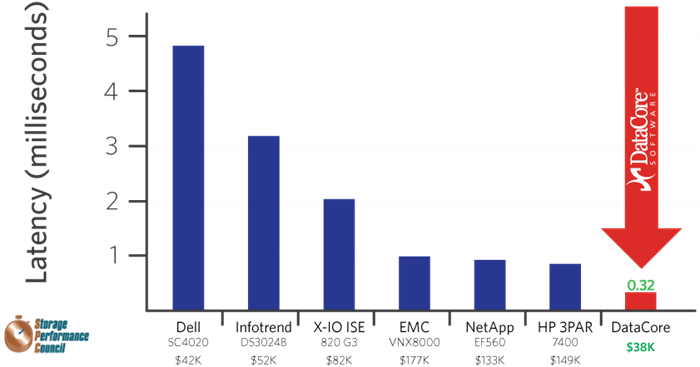
ESG Lab reviewed DataCore’s recently-published Storage Performance Council SPC-1 benchmark results. “DataCore has published an excellent result of 459,290 SPC-1 IOPS at 100% load with an average response time of only 0.32 milliseconds in a hyper-converged configuration1,” continued Palmer. “The 0.32 millisecond result at 100% load is the fastest response time ever reported by SPC-1, and showcases the power of parallel I/O software to significantly reduce the time it takes for applications to access, store, and update their data.”

DataCore set a new SPC-1 price-performance record. At full load, SANsymphony was responding at nearly two orders of magnitude below the 30 milliseconds response time threshold set by the Storage Performance Council and at 0.32 milliseconds, it is three times faster than the one milliseconds threshold considered to be the standard for all-flash systems.

ESG stated that the DataCore SPC-1 result proves its suitability for response time sensitive applications (e.g., Virtualization and Database workloads, OLTP, ERP, etc.) and demonstrates the headroom available to scale up and scale out to much larger configurations and capacities.

  • Simplifies VMware vSphere Storage Management: Self-Provisioning with VVols
Administrators crave the simplicity, power and fine-grain control promised by vSphere Virtual Volumes (VVols); however, most current storage arrays and systems do not support VVols. With DataCore enabled, virtually any storage becomes VVol capable allowing VMware vSphere administrators to self-provision virtual volumes from virtual storage pools -- and instantly specify the capacity and class of service needed for their applications without having to know anything about the storage or underlying hardware.

ESG Lab tested DataCore self-provisioning VVols. In the testing scenario, ESG set up Platinum, Gold, Silver, and Bronze policies to define different levels of service. DataCore made provisioning storage a seamless, integrated part of VM creation, empowering administrators to provision storage for virtual machines using predefined storage policies that were able to define performance, availability, and locality of data without ever having to touch the back-end storage.

DataCore automatically took care of the entire behind-the-scenes configuration, which is the responsibility of specialized storage administrators in traditional storage environments. ESG Lab reported that it was impressed with the speed, simplicity, and completeness of the DataCore integration. Virtual machines based on these predefined profiles were created in minutes using native VMware tools. ESG noted that this capability is particularly of value as much of the existing storage in data centers can never be retrofitted to support VVols, so the fact that SANsymphony extends VVols self-provisioning to existing storage investments and any new devices not yet able to support VVols is a powerful capability.

  • Automates Infrastructure-wide Storage Tiering to Maximize Cost-Effective Performance
ESG Lab also validated the business value of DataCore’s automated storage tiering. All performance testing was completed using test tools to simulate a typical OLTP workload. ESG first measured the performance on a non-tiered storage pool using a SAS disk. Next, an SSD was added to the storage pool. The software immediately started the rebalancing process of tiering, moving hot, or frequently accessed, data blocks from the SAS disk to the higher performance flash disk.
After completing the rebalancing process, the DataCore solution dedicated all resources to performing storage operations for the application. The effect of storage tiering was immediately visible, the DataCore software reported a total of 1,392 IOPS—a 700% improvement over the non-tiered storage pool.

  • Supports Continuous Availability, Metro-wide Clustering, Remote Disaster Recovery, Advanced Data Protection and Automated Failover and Self-healing Functionality
ESG Lab further validated that DataCore SANsymphony and Hyper-converged Virtual SAN provide an array of advanced data protection capabilities that can cost-effectively satisfy the most stringent business continuity and disaster recovery requirements. Synchronous mirroring across metropolitan areas, automated failover and self-healing, full and incremental snapshots, roll-back in time 

Continuous Data Protection (CDP), and asynchronous remote replication to distant disaster recovery sites can all be used without being dependent on any specific model or brand of storage device. For example, customers can take advantage of a hyper-converged system at a remote site and establish it as a contingency site for larger data centers.

ESG also noted that DataCore’s CDP capability was easy to configure and use, enabling rollback to a specific point in time without having to create multiple snapshots. An ideal solution for recovering the state of applications and configurations prior to bad events when snapshots were not invoked or to recreate ‘any-point in time’ restores.

View the ESG Lab Report and the Top 10 Biggest Storage Challenges
In addition to the lab report on DataCore, ESG recently conducted a survey of 373 IT professionals and respondents who were asked to identify what they would consider to be their biggest challenges with respect to their storage environment. As one might expect from a captive audience of server virtualization users, there was significant focus on both data growth and data protection (each cited by 26% of respondents), as well as staff costs and data migration (coming in at 23% each). Perhaps of greatest interest and significance, however, is that hardware costs (27%) was the most-cited storage challenge.

Bottom-line, in addition to the added flexibility to deal with growth and change, overcoming total cost of ownership including the rising people and hardware costs are now the primary business motivators driving the increased momentum to deploy software-defined storage solutions such as those from DataCore.

View the complete ESG Lab Report and Survey Information here.


Friday, 29 January 2016

DataCore’s Parallel I/O Software Runs Enterprise Storage and Application Workloads at $0.08 per SPC-1 IO/s


While driving fastest response times ever reported
DataCore Software Corporation announced a world record for price-performance using the industry's recognised and peer reviewed storage benchmark, the Storage Performance Council's SPC-1.


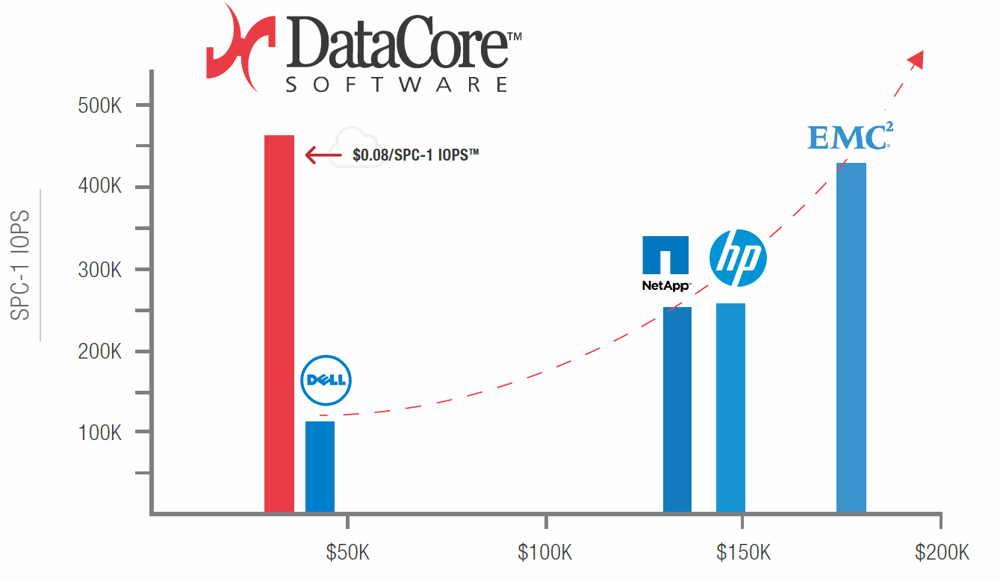
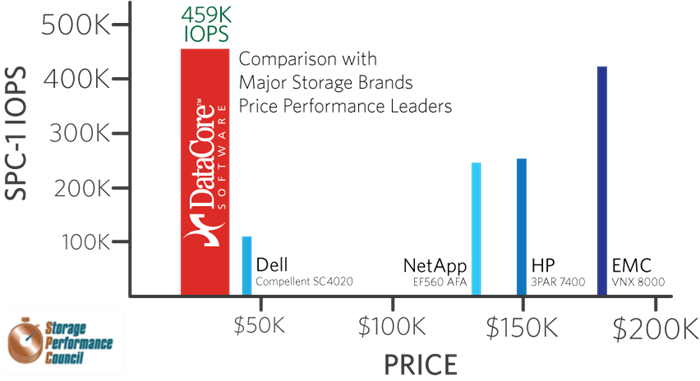
Thanks largely to its parallel I/O software that harnesses the untapped power of multi-core processors, this achievement places the company with an audited SPC-1 price-performance of $0.08 or 0.05 pence per SPC-1 IO/s [1] and as the clear-cut leader in SPC-1 price-performance overall. DataCore certified its results on a powerful but compact 2U Lenovo's system x3650 M5 multi-core server featuring Xeon E5-2600 v3 series processors with a mix of flash SSD and disk storage. On this same platform, the company also recorded the fastest response times ever attained, even compared to the many all-flash arrays and multi-million dollar name brand systems that have published SPC-1 results.

"With these first certified results, DataCore has put a stake in the ground to demonstrate our parallel I/O performance and hyper-converged capability. For us, this is just the beginning. Look for future benchmarking to incorporate multi-node HA configurations and to demonstrate I/O originating from both inside and outside the servers - the future for all storage systems," stated Ziya Aral, chairman, DataCore. "We have only just begun to show the potential of our inherently parallel I/O architecture."

Hyper-converged system handles compute, parallel I/O processing and storage workloads
Notably, the record-breaking price-performance results were achieved on a hyper-converged solution capable of servicing both enterprise storage requirements and demanding database and transaction processing application workloads - all running together on the same platform.

Hyper-converged systems must demonstrate that they can cost-efficiently handle combined enterprise storage and application workloads. Unlike SPC-1 results that characterise only external storage systems excluding the servers used to generate the load, company's $0.08 per SPC-1 IO/s result includes the cost to generate the workload and, therefore, encompasses the total cost and end-to-end requirements for running the enterprise application.

"We'd like to see others, like Nutanix and SimpliVity, publish SPC-1 benchmark numbers to reveal how they fare against our record-breaking SPC-1 Price-Performance results. Then customers can clearly assess the cost implications of these alternatives," challenges George Teixeira, CEO, DataCore. "There's been much speculation about how these systems perform under I/O-intensive workloads generated by mission-critical enterprise applications. Using the peer-reviewed SPC-1 full disclosure process provides an objective frame of reference for making comparisons prior to any buying decisions."

The Results: Record-breaking price-performance for both storage and hyper-converged
For the benchmark, the company used an off-the-shelf, hyper-converged system targeting enterprise OLTP and latency-sensitive database applications rated for 459,290.87 SPC-1 IO/s, with a total cost for hardware, software and three years of support coming in at $38,400.29, making it the top SPC-1 price-performance result of $0.08 per SPC-1 IO/s. That is a 300% improvement over the previous record of $0.24 per SPC-1 IO/s [2] attained by the Infortrend EonStor DS 3024B and less than 25% of the cost of popular top-of-the-line storage arrays including EMC VNX 8000 [3], NetApp EF560 [4] All Flash Array, Dell Storage SC4020 [5], and HP 3PAR StoreServ 7400 [6].

The company and IBM are the only companies to benchmark a hyper-converged system where the SPC-1 applications and storage workloads they generate are both serviced on the same platform. This means that company's $38,400.29 price includes not only the storage components, but all of the host server resources and the hypervisor software needed to run the enterprise database/OLTP workloads generated by the benchmark. For comparison, the only other hyper-converged system with publicly reported SPC-1 results is an IBM Power 780 Server. Their SPC-1 price-performance result is $4.56 per SPC-1 IO/s [7]. That system attained 780,081.02 SPC-1 IO/s at a total price of $3,557,709.00, or roughly 91 times more costly than the firm's solution.

Company's adaptive parallel I/O technology exploits power of multi-core CPUs
The price-performance ratings can be attributed in major part to company's Adaptive Parallel I/O techniques intrinsic to the design of the SANsymphony-V software-defined storage services platform. The firm executes many independent I/O streams simultaneously across multiple CPU cores, reducing the latency to service and process I/Os by taking full advantage of cost-effective but dense, multi-core servers such as the Lenovo System X machines. Competing products serialise I/O limiting their throughput and slowing their response times.


"Lenovo initially approached us to run the demanding SPC-1 enterprise workload benchmark. They wanted proof we could fully harness the power of their multi-core servers given the abundance of unsubstantiated performance claims circulating in hyper-converged circles," continued Teixeira. "They soon realized with parallel I/O, we had a rocket ship in our hands."

"Lenovo is excited to partner with DataCore to disrupt the storage marketplace providing customers the best price and performance in the industry" stated Chris Frey, VP and GM, Lenovo North America. "DataCore's industry-leading SPC-1 results on Lenovo System x demonstrate the performance, innovation and reliability that Lenovo is delivering to meet the growing storage needs to our customers."

SPC-1 Benchmark - Tested/priced configuration
The SPC-1 performance testing is designed to demonstrate a system's performance capabilities for business-critical enterprise workloads typically found in database and transaction processing environments. The audited configuration that was tested and priced includes SANsymphony-V parallel I/O software on a Lenovo System x3650 M5 multi-core server featuring Xeon E5-2600 v3 series processors running Windows Server, equipped with 16 SSDs and 8 HDD drives. The company also supports Hyper-V, VMware ESXi, Linux KVM and other hypervisor-based solutions. It can also run directly on Windows servers when server virtualisation is not appropriate.

'Less is more' with hyper-converged virtual SAN and software-defined storage
SANsymphony-V software reduces the I/O limitations and bottlenecks that restrict the number of VMs and workloads that can be consolidated on server and hyper-converged platforms. The software enables industry-standard x86 servers to gain the essential storage functionality needed to meet today's demanding tier-1 business application requirements. It runs on off-the-shelf servers and works infrastructure-wide across all types of storage (flash, disk and cloud) to automate and optimise performance and resource allocation.

Company's parallel I/O software takes advantage of today's advanced generation of multi-core server platforms - allowing companies to increase productivity and server consolidation savings by supporting the I/O needed to run more VMs and more application workloads faster and at a much lower cost.

Monday, 11 January 2016

2016: The Parallel IO Revolution is Underway, Servers are the New Storage


By George Teixeira, CEO and President, 
DataCore Software 
Key Points Shaping DataCore’s Views in 2016 


Parallel I/O software and multicore technology will transform IT productivity in 2016The melding of the server and storage worlds along with advances in parallel I/O software will revolutionize business productivity and transform our industry. Similar to server virtualization, the impact will be dramatic. Here are some of the key points shaping DataCore's views in 2016:

1. Servers are the new storage
A major transformation is underway as traditional storage systems are being replaced by commodity servers and software-defined solutions that can harness their power to solve the growing storage problem. Simply put, storage and data services will inevitably become yet another 'application workload' running on cost-efficient server platforms. This new wave of server-based storage systems are already having an impact. They are being marketed as server-SANs, virtual SANs, web-scale, scale-out and hyper-converged systems. However, when you look underneath the fancy marketing, they are pretty much a collection of standard off-the-shelf servers, flash cards and disk drives - the software defines their value differentiation.


Why has this change happened? Traditional storage vendors with specialized systems can no longer keep up with Moore's Law and the pace of cost savings and innovations that generic server platforms can deliver. Dell buying EMC is indicative of the change and the need to merge the server and storage worlds to remain competitive. Parallel I/O software and the ability to harness multicore server technology will be a major game-changer in 2016. In combination with software-defined storage, it will lead to a productivity revolution and establish 'servers as the new storage.'

2. Parallel I/O software and multi-core technology will revolutionize the IT world in 2016. 

The modern microprocessor universe started in the 1970's, and it along with Moore's Law drove two major paths of technology advances: the first resulted in faster more efficient uniprocessors which directly led to the PC revolution and to today's pervasive use of microprocessors in everything from smartphones to intelligent devices. The second path was parallel computing which set out to harness the power of many microprocessors. While parallel computing started with a flurry, the pace of advances were ultimately stifled by a lack of commodity parallel computing hardware, the overshadowing and rapid pace of advances in uniprocessor clock speeds that resulted from Moore's Law and most importantly by the lack of available software to do parallel work. Therefore, parallel computing for the most part remained an exotic discipline which required too much specialization for more general business use.


While faster clock speeds drove the PC revolution what went unnoticed was that the silicon vendors began to put many cores on the same platform (more transistors became more cores) and the result is that multicores are everywhere. In effect parallel processing power is now readily available, but there is still a lack of software to fully use its power. Bottom-line, the promised parallel computing revolution as a generic capability was put on hold awaiting software to advance.We are now at that critical turning point with software.
The parallel processing revolution is happening right now. DataCore recently set the new world record on price-performance and did it on a hyper-converged platform (on the Storage Performance Council's peer reviewed SPC-1 benchmark). DataCore also reported the best performance per footprint and the fastest response times ever. Bottom-line, today's multicore servers and software can 'do far more with less' and dramatically change the economics and productivity one can achieve.

Parallel I/O software will overcome the I/O bottleneck holding back our industry. It harnesses the power of multicores to dramatically increase productivity - and as a result it will revolutionize the industry.

3. Dramatic performance and productivity gains will transform hyper-converged and software-defined storage; get ready for a giant leap forward in 2016 

Finally, the hype around hyper-converged has continued to grow. From the marketing, one would believe it is the panacea to all problems. However, consumers and enterprises are realizing that they create new silos to manage and there are multiple limitations with the current offerings, particularly in terms of the scale and performance of those solutions to effectively handle enterprises-class workloads. As 2016 progresses, many customers will find themselves looking for solutions that can bring the ease of use benefits but also be easily integrated within company infrastructures with both existing investments and future technologies. Users are looking forward to the next stage of hyper-converged technology deployments where they don't have to sacrifice performance and interoperability with the rest of their investments.

Only a software-defined storage layer combined with parallel I/O software can effectively manage the power of multicore servers, migrate and manage data across the entire storage infrastructure, incorporate flash and hyper-converged systems without adding extra silos, and effectively utilize data stored anywhere in the enterprise or in the cloud. By untapping the power within standard multi-core servers, data infrastructures will realize tremendous consolidation and productivity benefits from parallel I/O technologies.

The impact is dramatic, it translates into much greater cost savings and productivity by allowing a new level of consolidation far beyond server virtualization alone and enabling systems to truly 'do more with less.' Application performance, enterprise workloads and greater consolidation densities on virtual platforms won't have to be held back by the growing gap between compute and I/O.

This combination of powerful software and servers will drive greater functionality, more automation, and comprehensive services to productively manage and store data across the entire data infrastructure. It will lead to a new era where "servers are the new storage" and the benefits of multi-core parallel processing can be applied universally. These advances which are already before us are key to solving the problems caused by slow I/O and inadequate response times that have been responsible for holding back application workload performance and cost savings from consolidation. These advances - multicore processing, parallel I/O and software-defined storage- collectively, are fundamental to achieving the next giant leap forward in business productivity. 

SearchStorage: Multicore processors mark next era of storage…Tick-Tock


Multicore processor technology represents not only next era in storage, but that everything old is new again.

From time to time, in presentations by tech vendors, one hears reference to a "tick-tock." Tick-tock is jargon describing a perceived pattern in the events that occur over a designated time frame. In recognizing such a pattern, the tick-tock narrative provides an orderly perspective on the seemingly great disorder of technological advancement, while at the same time providing a framework for predicting the future. Both make us feel like the future is less scary.

As we'll discuss in this article, multicore processors could very well be the next tick-tock for storage…

…Multicore the new tick-tock
Multicore processors have been the basis of the new tick-tock for some time now. Year after year, we are presented with CPUs offering double the number of processor cores on the same die, even though chip speeds have not increased significantly or at all…


…Unleash the power of multicore, multithreading chips
To really unlock the potential power of multicore processors and multithreading chips, we would need to get back to multiprocessing, parallel computing design.

DataCore Software is the first to revisit these concepts, which co-founder and Chairman of the Board Ziya Aral helped to pioneer in the 1980s. The company has found a way to take a user-designated portion of the logical cores available on a server and to allocate them specifically for storage I/O handling.

The technique they are using is getting increasingly granular and will eventually enable very specific processor resource allocation to the I/O processing of discreet workload. Best of all, once set, it is adaptive and self-tunes the number of multicore processors being used to handle I/O workloads.

DataCore's Storage Performance Council SPC-1 benchmark numbers are telling: they have blown the socks off of the hardware guys in terms of storage performance while reducing the cost per I/O well below the current low-cost leader -- using any and all off-the-shelf interconnects and storage devices.

We are about to enter a whole new era with a completely new tick-tock for storage -- and perhaps for the full server-network-storage stack -- based on multiprocessor architecture and engineering applied to multicore processor-driven systems.

Everything old is new again.


Sunday, 10 January 2016

Multi-Core Chips, IO processing and More; Virtualization Review Crystal Ball Predictions for 2016?


Virtualization Review’s The Infrastruggle Blog: 4 Possibly Correct Predictions for 2016

Excerpt:
…Better Use of Multi-Core Chips 
With the release of DataCore Software Parallel I/O technology, I expect to see a flood of parallel I/O woo enter the market. Parallel I/O involves the use of spare logical CPU cores ganged together into a very fast I/O processing engine to deliver phenomenal throughput improvements without much cost (you already own the multi-core processor). DataCore has paved the way to an extremely low-cost, high-performance storage tier by combining its P-I/O algorithm with its storage virtualization capabilities that include adaptive caching and interconnect load balancing. I suspect that many vendors will seek to pursue a comparable strategy, though most lack the experience in multiprocessor architecture that DataCore still has on staff.

Read Toigo’s full post and predictions at 4 Possibly Correct Predictions for 2016

1. The Zettabyte Apocalypse Will Not Come in 2016
2. Better Use of Multi-Core Chips
3. Tape Will Continue Its Comeback
4. Mainframes Are Cool Again


Monday, 4 January 2016

Star Wars, the Force and the Power of Parallel Multicore Processing: Getting More Out of Virtualized Workloads

By George Teixeira, President & CEO, DataCore Software

During the 80’s, the original Star Wars movies featured amazing future technology and were all about “the power of the Force.” The latest movie has now broken all box office records and got me thinking about how much IT and computing technology has progressed over the years but yet, there is still so much left untapped.

Yes, several of the envisioned gains have come true – many of these driven by Moore’s Law and the growing force of the microprocessor revolution. For example, server virtualization software such as VMware radically redefined consolidation savings and productivity, CPU clock speeds got faster and microprocessors became commodities used everywhere – powering PCs, laptops, smart phones and intelligent devices of all types. But the full force and promise of using many microprocessors in parallel, what is now called ‘multicores,’ still remains largely untapped and I/O continues to be the major bottleneck holding back the IT industry from achieving the next revolution in consolidation, performance and productivity.

Virtual computing is still bottlenecked by I/O. Just as city drivers can only dream about flying vehicles as gridlock haunts their morning commute, IT is left wondering if they will ever see the day when application workloads will reach light speed.

How can it be that with multi-core processing, virtualized apps, abundant RAM and large amounts of flash, you still have to deal with I/O-starved virtual machines (VMs) while many processor cores remain idle? Yes, you can run several independent workloads at once on the same server using separate CPU and memory resources, but that’s where everything begins to break down. The many workloads in operation generate concurrent I/O requests yet only one core is charged with I/O processing. This architectural limitation strangles the life out of application performance. Instead of one server doing vast quantities of work, IT is forced to add more servers and racks to deal with I/O bottlenecks – this sprawl goes against the ‘consolidation and productivity savings’ which is the basic premise and driver of virtualization.

All it takes, then, is a few VMs running simultaneously on multi-core processors churning out almost inconceivable volumes of work and you quickly overwhelm the one processor tasked with serial I/O. Instead of a flood of accomplished computing, a trickle of I/O emerges. IT is left feeling like the kids who grew up watching Star Wars who ask – where are our flying starships and when can we travel at light-speed?!

The good news is that all is not lost. DataCore has a number of bright minds hard at work to bring a revolutionary breakthrough for I/O to prime time, DataCore Parallel I/O technology lets virtualized traffic flow through without slowdown. Its unique software-defined parallel I/O architecture is needed to capitalize on today’s powerful multi-core/parallel processing infrastructure. By enlisting software to drive I/O processing across many different cores simultaneously, this eradicates I/O bottlenecks and drives a higher level of consolidation savings and productivity. The better news is that this technology is already on the market today.

Just like Star Wars has shattered the world record, check out how DataCore recently set the new world record on price-performance and on a hyperconverged system (on the Storage Performance Councils peer reviewed SPC1 benchmark). DataCore also reported the best performance per footprint and the fastest response times ever and so while the numbers do not actually reach light-speed, DataCore has lapped the field not once but multiple times. See for yourself the latest benchmark results in this article that appeared in Forbes: The Rebirth of Parallel I/O.

How? DataCore’s software actively senses the I/O load being generated by concurrent VMs. It adapts and responds dynamically by assigning the appropriate number of cores to process the input and output traffic. As a result, VM’s no longer sit idle waiting on a serial I/O thread to become available. Should the I/O load lighten, however, CPU cores are freed to do more computational work.

This not only solves the immediate performance problem facing multi-core virtualized environments, it significantly increases the VM density possible per physical server. It allows IT to do ‘far more with less.’ This means fewer servers or racks and less space, power and cooling are needed to get the work done. In effect, it achieves remarkable cost reductions through maximum utilization of CPU cores, memory and storage while fulfilling the productivity promise of virtualization.

You can read more about this in DataCore’s white paper, “Waiting on I/O: The Straw that Broke Virtualization’s Back.” 

Friday, 18 December 2015

Making Data Highly Available on Flash and DRAM

George Teixeira, CEO & President and Nick Connolly, Chief Scientist at DataCore Software discuss how DataCore's Software-Defined Storage solution takes advantage of flash and DRAM technologies to provide high availability and the right performance for your applications.


How Software-Defined Storage Enhances Hyper-converged Storage 
One of the fundamental requirements for virtualizing applications is shared storage. Applications can move around to different servers as long as those servers have access to the storage with the application and its data. Typically, shared storage takes place over a storage network known as a SAN. However, SANs typically run into issues in a virtual environment, so organizations are currently looking for new options. Hyper-converged infrastructure is a solution that seems well-suited to address these issues.
This following white paper describes how to conquer the challenges of using SANs in a virtual environment and why organizations are looking into hyper-converged systems that take advantage of software-defined storage as a solution to provide reliable application performance and a highly available infrastructure.

Saturday, 12 December 2015

DataCore achieves SAP-HANA certification, first Software-defined Storage certified to operates across multiple vendors

We are pleased to announce the certification of SANsymphony™-V with the SAP HANA® platform. DataCore™ SANsymphony-V is storage infrastructure software that operates across multiple vendors’ storage systems to deliver the performance and availability required by demanding enterprise-class applications such as SAP HANA.
What is SAP HANA?
The SAP HANA in-memory database lets organizations process vast amounts of transactional, analytical and application data in real-time using a computer’s main memory. Its platform provides libraries for predictive, planning, text processing, spatial and business analytics.
Key Challenges for SAP HANA implementation:
SAP HANA demands a storage infrastructure to process data at an unprecedented speed and has zero-tolerance for downtime. Most organizations store entire SAP HANA multi-terabyte production systems on high-performance Tier 1 storage to meet the performance required during peak processing cycles, such as “period end,” or seasonal demand spikes.  This practice presents the following challenges to IT departments:
  • Tier 1 storage is expensive to deploy and significantly impact the IT budget.
  • Tier 1 storage is limited to its physical constraints when it comes to data availability, staging, reporting, and test and development.
  • Managing multiple storage systems (existing and new) can add considerable cost and complexity; routine tasks like test/dev and reporting are difficult to manage.
Benefits of DataCore
DataCore SANsymphony-V is the first Software-defined Storage solution that is certified to operate across multiple vendors’ SAP HANA-certified storage systems to deliver the performance and availability required.  DataCore SANsymphony-V software provides the essential enterprise-class storage functionality needed to support the real-time applications offered by the SAP HANA® platform.
With DataCore, SAP HANA customers gain:
  • Choice:  Companies have the choice of using existing and/or new SAP HANA certified storage systems, with the ability to seamlessly manage and scale their data storage architectures as well as giving them more purchasing power (no vendor lock-in)
  • Performance:  Accelerate I/O with DataCore™ Adaptive Parallel I/O architecture as well as caching to take full advantage of SAP HANA. in-memory capabilities to transform transactions, analytics, text analysis, predictive and spatial processing.
  • Cost-efficiency:  DataCore reduces the amount of Tier 1 storage space needed, and makes the best use of lower cost persistent HANA-certified storage.


 DataCore SANsymphony-V infrastructure software is the only SAP HANA-certified SDS solution that can be used together with an SAP-certified storage solution from Fujitsu, Huawei, IBM, Dell, NEC, Nimble Storage, Pure Storage, Fusion-io, Violin Memory, EMC, NetApp, HP and Hitachi.

Tuesday, 8 December 2015

Software Defined Storage meets Parallel I/O; The impact on Hyperconvergence


                    George Crump Storage Switzerland

http://storageswiss.com/2015/12/01/software-defined-storage-meets-parallel-io/

In terms of storage performance, the actual drive  is no longer the bottleneck. Thanks to flash storage, attention has turned to the hardware and software  that surrounds them, especially the capabilities of the CPU that drives the storage software. The importance of CPU power is evidenced by the increase in overall storage system performance when an all-flash array vendor releases a new storage system. The flash media in that system doesn’t change, but overall performance does increase. But that increase in performance is not as optimal as it should be. The lack of achieving optimal performance is a result of storage software not taking advantage of the parallel nature of the modern CPU.

Moore’s Law Becomes Moore’s Suggestion

Moore’s Law is an observation by Intel co-founder Gordon Moore. The simplified version of this law states that number of transistors  will double every two years. IT professionals assumed that meant that the CPU they buy would get significantly faster every two years or so. Traditionally, this meant that the clock speed of the processor would increase, but recently Intel has hit a wall because increasing clock speeds also led to increased power consumption and heat problems. Instead of increasing clock speed, Intel has focused on adding more cores per processor. The modern data center server has essentially become a parallel computer.

Multiple cores per processor are certainly an acceptable method of increasing performance and continuing to advance Moore’s law. Software, however, does need to be re-written to take advantage of this new parallel computing environment. Parallelization of software is required by operating systems, application software and of course storage software. The re-coding of software to make it parallel is challenging. The key is to manage I/O timing and locking, making multli-threading a storage application more difficult than a video rendering project for example. As a result, it has taken time to get to the point where the majority of operating systems and application software has some flavor of parallelism.

Lagging far behind in the effort to take full advantage of the modern processor is storage software. Most storage software, either built into the array or the new crop of software defined storage (SDS) solutions, are unable to exploit the wide availability of processing cores. They are primarily single core. As a worst case, they are only using one core per processor; at its best, they are using one core per function. If cores are thought of as workers, it is best to have all the workers available to all the tasks, rather than each worker focused on a single task.

Why Cores Matter

The importance of using cores efficiently has only recently become important. Most legacy storage systems were hard drive based, lacking advanced caching or flash media to drive performance. As a result, the need to support efficiently the multi-core environment was not as obvious as it is now that systems have a higher percentage of flash storage. The lack of multi-core performance was overshadowed by the latency of the hard disk drive. Flash and storage response time is just one side of the I/O equation. On the other side, the data center is now populated with highly dense virtual environments or, even more contentious, hyper-converged architectures. Both of these environments generate a massive amount of random I/Os that, thanks to flash, the storage system should be able to handle very quickly. The storage software is the interconnect between the I/O requester and the I/O deliverer and if it can’t efficiently support all the cores it has at its disposal then it becomes the bottleneck.

All storage systems that leverage Intel CPUs face the same challenge; how to leverage CPUs that are increasing in cores, but not in raw speed. In other words, they don’t perform a single process faster but they do perform multiple processes at the same speed simultaneously, netting in faster overall completion time, if the cores are used efficiently. Storage software needs to adapt and become multi-threaded so it can distribute I/O across these functions, taking full advantage of multiple cores.

For most vendors this may mean a complete re-write of their software, which will take time, effort and risk incompatibility with their legacy storage systems.

How Vendor’s Fake Parallel I/O

Vendors have tried several techniques to try to leverage the reality of multiple cores without specifically “parallelizing” their code. Some storage system vendors have tried to tie specific cores to specific storage processing tasks. For example, one core may handle raw inbound I/O while another handles RAID calculations. Other vendors will distribute storage processing tasks in a round robin fashion. If cores are thought of as workers, this technique treats cores as individuals instead of a team. As each task comes in each core is assigned a task, but only that core can work on that task. If it is a big task, it can’t get help from the other cores. While this technique does distribute the load, it doesn’t allow multiple workers to work on the same task at the same time. Each core has to do its own heavy lifting.

Scale-out storage systems are similar in that they leverage multiple processors within each node of the storage cluster, but that are not granular enough to assign multiple cores to the same task. They, like the systems described above, typically have a primary node that acts as a task delegator and assigns the I/O to a specific node, and that specific node handles storing the data and managing data protection.

These designs count on the I/O to come from multiple sources so that each discrete I/O stream can be processed by one of the available cores. These systems will claim very high IOPS numbers, but require multiple applications to get there. They work best in an environment that requires a million IOPS because it has ten workloads all generating 100,000 IOPS instead of an environment that has one workload that generates 1 million IOPS and no other workloads over 5,000. To some extent vendors also “game” the benchmark by varying I/O size and patterns (random vs. sequential) to achieve a desired result. The problem is this I/O  is not the same as what customers will see in their data centers.

The Impact of True Parallel I/O

True parallel I/O utilizes all the available cores across all the available processors. Instead of siloing a task to a specific core, it assigns all the available cores to all the tasks. In other words, it treats the cores as members of a team. Parallel I/O storage software works well on either type of workload environment, ten generating 100k IOPS or one generating 1 million IOPS.

Parallel I/O is a key element in powering the next generation data center because the storage processing footprint can be dramatically reduced and can match the reduced footprint of solid-state storage and server virtualization. Parallel I/O provides many benefits to the data center:


  • Full Flash Performance


  • As stated earlier, most flash systems show improved performance when more processing power is applied to the system. Correctly leveraging cores with multi-threading, delivers the same benefit without having to upgrade processing power. If the storage software is truly parallel, then the storage software can deliver better performance with less processing power, which drives costs down while increasing scalability.


    • Predictable Hyper-Converged Architectures


    • Hyper-converged architectures are increasing in popularity thanks to available processing power at the computer tier. Hypervisors do a good job of utilizing multi-core processors. The problem is that a single threaded storage software component becomes the bottleneck. Often the key element of hyper-convergence, storage software, is isolated to one core per hyper-converged node. These cores can be overwhelmed if there is a performance spike leading to inconsistent performance that could impact the user experience. Also to service many VMs and critical business applications, they typically need to throw more and more nodes at the problem, impacting the productivity and cost saving benefits derived from consolidating more workload on fewer servers. A storage software solution that is parallel can leverage or share multiple cores in each node. The result is more virtual machines per host, less nodes to manage and more consistent storage I/O performance even under load.


      • Scale Up Databases


      • While they don’t get the hype of modern NoSQL databases, traditional, scale up databases (e.g., Oracle, Microsoft SQL) are still at the heart of most organizations. Because the I/O stream is from a single application, they don’t generate enough independent parallel I/O so it can be distributed to specific cores. The parallel I/O software’s ability to make multiple cores act as one is critical for this type of environment. It allows scale up environments to scale further than ever.

        Conclusion

        The data center is increasingly becoming denser; more virtual machines are stacked on virtual hosts, legacy applications are expected to support more users per server, and more IOPS are expected from the storage infrastructure. While the storage infrastructure now has the right storage media (flash) in place to support the consolidation of the data center, the storage software needs to support the available compute power. The problem is that compute power is now delivered via multiple cores per processor instead of a single processor. Storage software that has parallel I/O will be able to take full advantage of the processor reality and support these dense architectures with a storage infrastructure that is equally dense.


        Monday, 7 December 2015

        DataCore Certifies Universal VVols - Brings VMware VVols Benefits to Existing Storage and to Non-VVol Certified Storage

        Universal Virtual Volumes: Extends VMware’s VVOL Benefits to Storage Systems that do not Support it
        Many VMware administrators crave the power and fine-grain control promised by vSphere Virtual Volumes (VVOLs). However, most current storage arrays and systems do not support it. Manufacturers simply cannot afford to retrofit equipment with the new VM-aware interface.
        DataCore offers these customers the chance to benefit from VVOLs on EMC, IBM, HDS, NetApp and other popular storage systems and all flash arrays simply by layering SANsymphony™-V storage virtualization software in front of them. The same is true for direct-attached storage (DAS) pooled by the DataCore™ Hyper-converged Virtual SAN.
        Now, vSphere administrators can self-provision virtual volumes from virtual storage pools -- they specify the capacity and class of service without having to know anything about the hardware.


        Friday, 4 December 2015

        DataCore and Fujitsu Announce New Hyper-Converged Appliances, SAP HANA-certification, Adaptive Parallel I/O Software and Universal Virtual Volumes (VVOLs)

         DataCore Software Corporation has unveiled second generation Storage Virtualization Appliance (SVA) and a new Hyper-Converged Appliance (HCA), both jointly developed and supported with Fujitsu Ltd. and available for shipment by end of the year.


        New opportunities are available for Fujitsu customers and partners as a result of DataCore achieving certification of SANsymphony-V storage virtualization for SAP HANA on Fujitsu ETERNUS storage.
        "Our partnership with DataCore continues to provide many benefits to our growing base of customers. Our joint solutions combine industry leading Fujitsu hardware platforms and DataCore software into SVA and HCA that help customers easily deploy and manage their enterprise solutions to run their core business applications. With today's certification, DataCore officially supports SAP HANA on Fujitsu ETERNUS storage and adds its software-defined storage features, performance acceleration and HA capabilities  to complement our SAP portfolio in an ideal way," says Jörg Brünig, senior director, Fujitsu.

        With SVA, Fujitsu and DataCore provide a series of tested turnkey appliances for SAN virtualization including 'call home' service and support from one source. In addition to the already established models, DataCore will showcase at the forum its second product generation SVA vNext. It combines the new Fujitsu PRIMERGY RX2560 M1 server generation with SANsymphony-V10 PSP4, making it more powerful in use.

        The partners are working together to meet the increasing demand for hyper-converged systems by providing a easy to deploy and use HCA. The Fujitsu DataCore HCA is a preconfigured 'Ready to Run' Appliance with integrated storage and the latest DataCore Virtual SAN software for data management, HA and optimised performance. The HCA is designed for SMBs and is a cost-effective solution for Hyper-V and VDI workloads, file and database services as well as iSCSI storage for external applications. Both new appliance solutions are expected to be available to the market by end of the year.

        SAP HANA-certification for SANsymphony-V with Fujitsu ETERNUS storage
        SAP has certified SANsymphony-V as the first software-based storage virtualization solution for SAP HANA. DataCore provides the essential enterprise storage functionality needed to support the real-time applications made possible by the SAP HANA platform. In SAP Integration and Certification Center (SAP ICC) the DataCore software has been successfully tested with Fujitsu ETERNUS DX storage. With DataCore´s hardware independent Software-Defined Storage approach, SAP HANA users can now expand existing storage infrastructures with the Fujitsu / DataCore combination to achieve an optimal price / performance ratio with the latest hardware and software technology in their SAP HANA environment.
        "The cooperation between DataCore and Fujitsu brings together leading technologies delivering tested, preconfigured and easy-to-integrate solutions with reliable support from a single source to our customers. The SAP HANA certification for SANsymphony-V now offers Fujitsu partners and resellers the opportunity to provide SAP HANA-users with effective storage solutions, regardless of which storage is being used today," says Stefan von Dreusche, director Central Europe, DataCore.

        DataCore Adaptive Parallel I/O Software and Universal Virtual Volumes
        On its booth, DataCore expands on the new DataCore Adaptive Parallel I/O Software. This technology allows for an adaptive, parallel I/O processing in multi core processors. Especially needed in workload-intensive data processing in OLTP, real-time analysis, business intelligence and datawarehouse systems as well as SQL, SAP and Oracle databases,  users will benefit from performance multipliers. With Parallel I/O technology, VMs can be packed more densely on hyper-converged systems and thus savings can be realised at a previously unmatched level. Another enhancement to DataCore's software-defined storage platform is the introduction of universal Virtual Volume (VVOL) support. VMware administrators can now deploy virtual drives via the vSphere interface from any storage hardware (disk subsystems, SSD arrays, DAS etc.) without bothering their storage administrator, even if they do not support VMware's VVOL.

        http://www.storagenewsletter.com/rubriques/systems-raid-nas-san/datacore-and-fujitsu-jointly-developed-storage-virtualization-and-hyper-converged-appliance/

        Sunday, 1 November 2015

        DataCore SANsymphony-V wins Reader’s Choice Award for Best Software Defined Storage Solution


        The readers of Storage-Insider and IT business have decided: DataCore wins the Reader's Choice Award for Best Software Defined Storage. In the readers' vote of Vogel IT Media DataCore prevailed with its SANsymphony-V software in the final against solutions from Dell, IBM  and FalconStor. The Platinum Award was presented at a gala event on 29 October.


        "We are particularly pleased and proud to receive this award because this choice was made by the readers of some of the most important publications in our industry. IT professionals have selected SANsymphony-V as the best Software Defined Storage solution", Stefan of Dreusche, Director Central Europe at DataCore Software says.


        http://datacore-speicher-virtualisierung.blogspot.com/2015/10/datacore-gewinnt-readers-choice-award.html

        Thursday, 22 October 2015

        Virtualization Review: Back to the Future in Virtualization and Storage – A Real Comeback, Parallel I/O by DataCore

        “It's a real breakthrough, enabled by folks at DataCore who remember what we were working on in tech a couple of decades back.”
        If you're on social media this week, you've probably had your fill of references to Back to the Future, the 1980s scifi comedy much beloved by those of us who are now in our 50s, and the many generations of video watchers who have rented, downloaded or streamed the film since. The nerds point out that the future depicted in the movie, as signified by the date on the time machine clock in the dashboard of a DeLorean, is Oct. 21, 2015. That's today, as I write this piece…

        Legacy Storage Is Not the Problem
        If you stick with x86 and virtualization, you may be concerned about the challenges of achieving decent throughput and application performance, which your hypervisor vendor has lately been blaming on legacy storage. That is usually a groundless accusation. The problem is typically located above the storage infrastructure in the I/O path; somewhere at the hypervisor and application software operations layer.
        To put it simply, hypervisor-based computing is the last expression of sequentially-executing workload optimized for unicore processors introduced by Intel and others in the late 70s and early 80s. Unicore processors with their doubling transistor counts every 24 months (Moore's Law) and their doubling clock speeds every 18 months (House's Hypothesis) created the PC revolution and defined the architecture of the servers we use today. All applications were written to execute sequentially, with some interesting time slicing created to give the appearance of concurrency and multi-threading.
        This model is now reaching end of life. We ran out of clock speed improvements in the early 2000s and unicore chips became multicore chips with no real clock speed improvements. Basically, we're back to a situation that confronted us way back in the 70s and 80s, when everyone was working on parallel computing architectures to gang together many low performance CPUs for faster execution.


        A Parallel Comeback
        Those efforts ground to a halt with unicore's success, but now, with innovations from oldsters who remember parallel, they're making a comeback. As soon as Storage Performance Council audits some results, I'll have a story to tell you about parallel I/O and the dramatic improvements in performance and cost that it brings to storage in virtual server environments.
        It's a real breakthrough, enabled by folks at DataCore who remember what we were working on in tech a couple of decades back.